
Welcome to the Bryozoa subsite on Invertebrate Paleontology!
Please enter a genera name to retrieve more information.
Rhombopora
Classification
Phylum:
Bryozoa
Subphylum:
Ectoprocta
Class:
Gymnolaemata
Order:
Cryptostomata
Suborder:
Rhabdomesina
Family:
Rhomboporidae
Formal Genus Name and Reference:
Rhombopora MEEK, 1872, p. 141
Type Species:
R. lepidodendroides, OD, ?Willard Sh., Penn., Nebraska City, Otoe Co., Neb., USA
Images
(Click to enlarge in a new window)
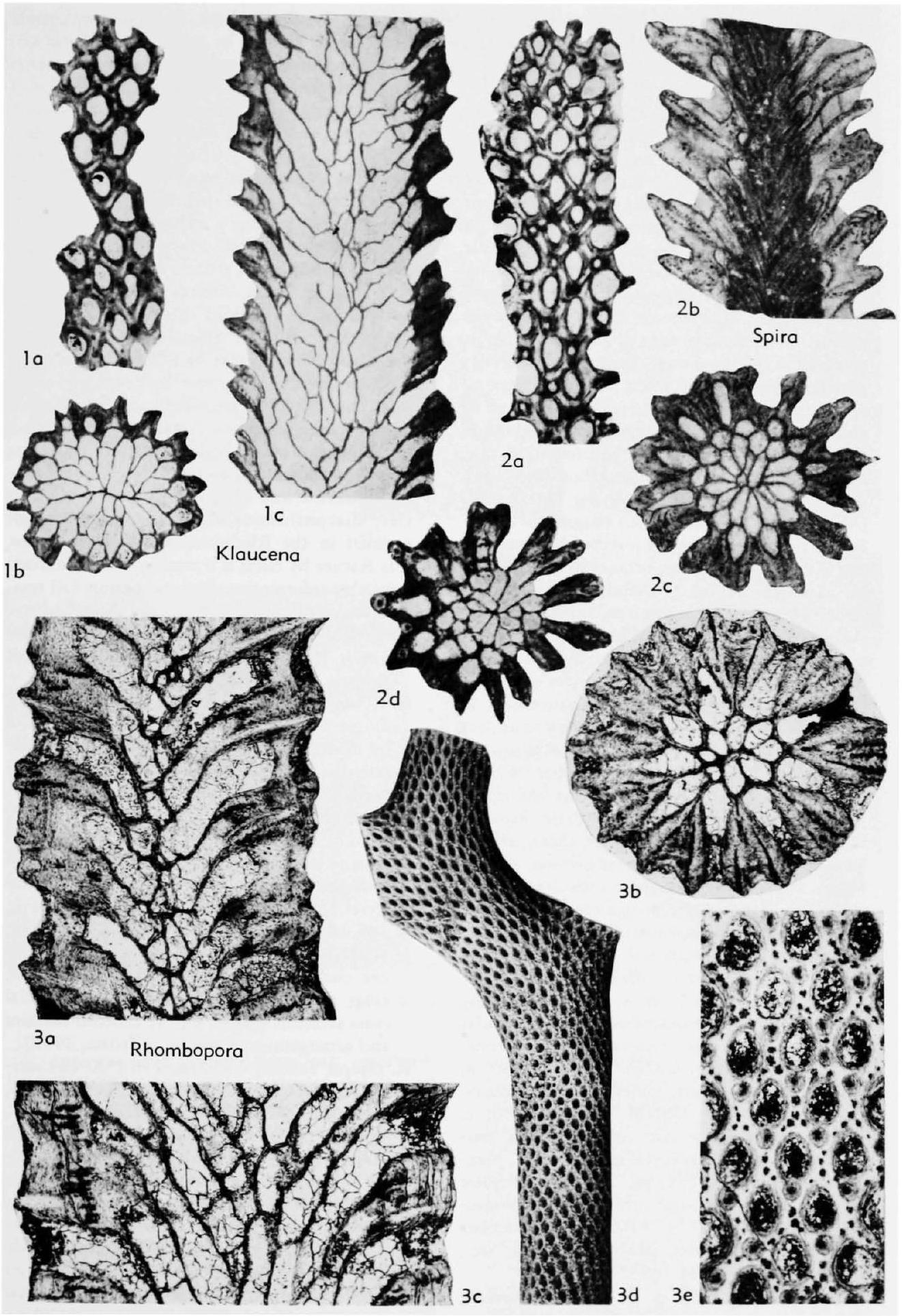 Fig. 286, 3a-e. *R. lepidodendroides, a, irregular branch axis, zooecial shapes, broad exozone, long. sec., lectotype, USNM 168360, x30, b, zooecial cross sections, lamellar profile, transv. sec., paralectotype, USNM 168360, x30, c, elongate zooecia near axis, zooecial shapes, narrow exozone, stylet arrangement, long. sec., paralectotype, USNM 168359, x30, d, irregular growth habit, apertural arrangement, paralectotype, USNM 240773, x10, e, living chamber outlines, acanthostyles, paurostyles, tang. sec., paralectotype, USNM 168359, x30.
Synonyms
Geographic Distribution
N.Am., Asia, S.Am.
Age Range
Beginning Stage in Treatise Usage:
U.Dev., L.Miss. (Osag.)
Beginning International Stage:
Tournaisian
Fraction Up In Beginning Stage:
80.6
Beginning Date:
349.17
Ending Stage in Treatise Usage:
U.Perm. (Dzhulf.)
Ending International Stage:
Wuchiapingian
Fraction Up In Ending Stage:
100
Ending Date:
254.24
Description
Zoarium with jointed branches in at least one species; branch diameters 0.7 to 4.5 mm, may vary between bifurcations. Apertural arrangement approximately rhombic, locally irregular. Metapores uncommon in some species; typically fewer than 1 metapore for every 15 zooecia. Axial region usually formed by irregular linear axis; intraspecifically, some zooecia parallel axis for short intervals, true axial zooecia not developed. Zooecial bases inflated; zooecia initially polygonal and irregular in cross section, becoming hexagonal. Zooecial divergence30°tfromaxisapproximately o 50°. Zooecial bend generally rounded; living chambers oriented 80° to 90° to branch surface. Zooecial length varied, usually 5 to 9 times diameter; longitudinal arrangement of zooecia regular to somewhat irregular. Diaphragms uncommon. Exozonal width from one-fifth to more than half branch radius. Lamellar profile V-shaped in exozone. In one species, semiannular monticulelike ridge developed by elongation of some autozooecia; other polymorphs absent in annulations. One or two acanthostyles proximal to each zooecial chamber; most stylets parallel to zooecia, a few less steeply inclined to surface than zooecia. Aktinotostyles common to abundant; diameters generally constant through exozone. Mural spines may be present in exozonal wall of zooecia. Some acanthostyles arising in endozone, most stylets arising in exozone. [Many more species have been assigned to Rbombopora than can be readily justified by comparison with the type species, bearing in mind ranges of variation in other rhabdomesine genera. Rhombopora is distinguished on branch size and shape, zooecial shape and orientation, and presence of acanthostyles, aktinotostyles, and only a few metapores. In many later species of Rhombopora, size increases, zooecial arrangement is locally irregular, the median axis becomes less well defined, there is some tendency toward development of axial zooecia, the zone of budding is somewhat broadened, most endozonal walls become relatively thin, and the exozone becomes relatively narrow. These characters are similar to those of some trepostomates. Rhombopora and its allies are here considered to be rhabdomesines because of the restricted nature of the budding locus, zooecial shape, and similarity to such unequivocal rhabdomesines as Orthopora.]
References
Meek, F. B., 1872, Report on the paleontology of eastern Nebraska: in F. V. Hayden, Final Report of the United States Geological Survey of Nebraska and Portions of the Adjacent Territories. . ., p. 81-239, 11 pl. U.S. Government Printing Office (Washington).
Museum or Author Information
Classification
Phylum:
Bryozoa
Subphylum:
Ectoprocta
Class:
Gymnolaemata
Order:
Cryptostomata
Suborder:
Rhabdomesina
Family:
Rhomboporidae
Formal Genus Name and Reference:
Rhombopora MEEK, 1872, p. 141
Type Species:
R. lepidodendroides, OD, ?Willard Sh., Penn., Nebraska City, Otoe Co., Neb., USA
Images
(Click to enlarge in a new window)
Fig. 286, 3a-e. *R. lepidodendroides, a, irregular branch axis, zooecial shapes, broad exozone, long. sec., lectotype, USNM 168360, x30, b, zooecial cross sections, lamellar profile, transv. sec., paralectotype, USNM 168360, x30, c, elongate zooecia near axis, zooecial shapes, narrow exozone, stylet arrangement, long. sec., paralectotype, USNM 168359, x30, d, irregular growth habit, apertural arrangement, paralectotype, USNM 240773, x10, e, living chamber outlines, acanthostyles, paurostyles, tang. sec., paralectotype, USNM 168359, x30.
Synonyms
Geographic Distribution
N.Am., Asia, S.Am.
Age Range
Beginning Stage in Treatise Usage:
U.Dev., L.Miss. (Osag.)
Beginning International Stage:
Tournaisian
Fraction Up In Beginning Stage:
80.6
Beginning Date:
349.17
Ending Stage in Treatise Usage:
U.Perm. (Dzhulf.)
Ending International Stage:
Wuchiapingian
Fraction Up In Ending Stage:
100
Ending Date:
254.24
Description
Zoarium with jointed branches in at least one species; branch diameters 0.7 to 4.5 mm, may vary between bifurcations. Apertural arrangement approximately rhombic, locally irregular. Metapores uncommon in some species; typically fewer than 1 metapore for every 15 zooecia. Axial region usually formed by irregular linear axis; intraspecifically, some zooecia parallel axis for short intervals, true axial zooecia not developed. Zooecial bases inflated; zooecia initially polygonal and irregular in cross section, becoming hexagonal. Zooecial divergence30°tfromaxisapproximately o 50°. Zooecial bend generally rounded; living chambers oriented 80° to 90° to branch surface. Zooecial length varied, usually 5 to 9 times diameter; longitudinal arrangement of zooecia regular to somewhat irregular. Diaphragms uncommon. Exozonal width from one-fifth to more than half branch radius. Lamellar profile V-shaped in exozone. In one species, semiannular monticulelike ridge developed by elongation of some autozooecia; other polymorphs absent in annulations. One or two acanthostyles proximal to each zooecial chamber; most stylets parallel to zooecia, a few less steeply inclined to surface than zooecia. Aktinotostyles common to abundant; diameters generally constant through exozone. Mural spines may be present in exozonal wall of zooecia. Some acanthostyles arising in endozone, most stylets arising in exozone. [Many more species have been assigned to Rbombopora than can be readily justified by comparison with the type species, bearing in mind ranges of variation in other rhabdomesine genera. Rhombopora is distinguished on branch size and shape, zooecial shape and orientation, and presence of acanthostyles, aktinotostyles, and only a few metapores. In many later species of Rhombopora, size increases, zooecial arrangement is locally irregular, the median axis becomes less well defined, there is some tendency toward development of axial zooecia, the zone of budding is somewhat broadened, most endozonal walls become relatively thin, and the exozone becomes relatively narrow. These characters are similar to those of some trepostomates. Rhombopora and its allies are here considered to be rhabdomesines because of the restricted nature of the budding locus, zooecial shape, and similarity to such unequivocal rhabdomesines as Orthopora.]
References
Meek, F. B., 1872, Report on the paleontology of eastern Nebraska: in F. V. Hayden, Final Report of the United States Geological Survey of Nebraska and Portions of the Adjacent Territories. . ., p. 81-239, 11 pl. U.S. Government Printing Office (Washington).