
Welcome to the Bryozoa subsite on Invertebrate Paleontology!
Please enter a genera name to retrieve more information.

Ptilodictya
Classification
Phylum:
Bryozoa
Subphylum:
Ectoprocta
Class:
Gymnolaemata
Order:
Cryptostomata
Suborder:
Ptilodictyina
Family:
Ptilodictyidae
Formal Genus Name and Reference:
Ptilodictya Lonsdale in MURCHISON, 1839, p. 676
Type Species:
Flustra lanceolata GOLDFUSS, 1829, p. 104, OD, glacial drift, "encrinite limestone, " ?U. Sil., Groningen, Ger.
Images
(Click to enlarge in a new window)
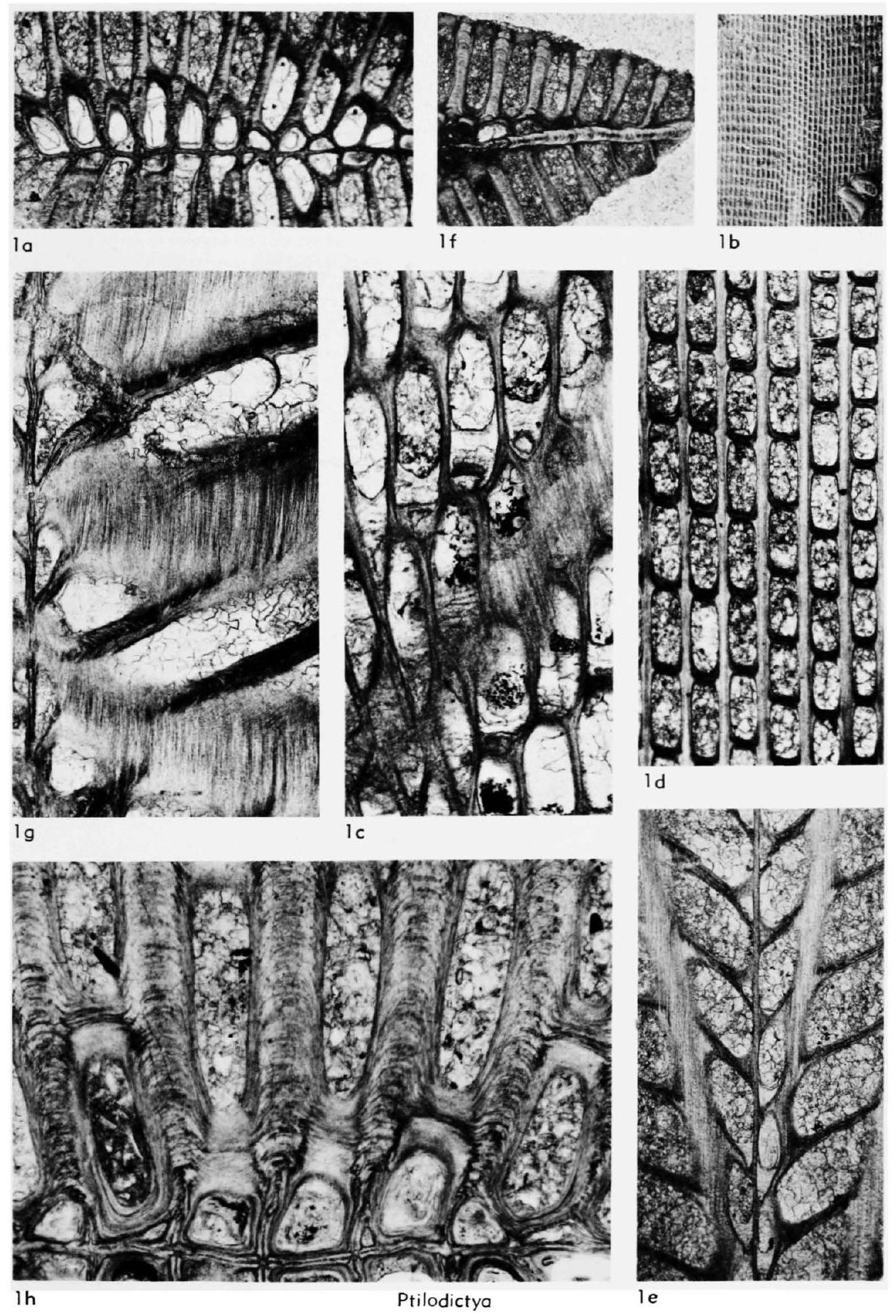 Fig. 240, la-b. *P. lanceolata (Goldfuss), Wenlock Ls., U. Sil., Dudley, Eng., a, mesotheca, straight longitudinal walls, slightly flexed transverse walls, transv. sec., USNM 137913, x30, b, autozooecia in distinct linear ranges, reticulate in lateral regions, smaller living chambers in mid zoarium, external view, USNM 137913, x4, c, indistinctly subhexagonal autozooecia in endozone, indistinct brown bodies near mesotheca, deep tang. sec., USNM 137913, x30, d, elliptical to subrectangular living chambers between structurally continuous longitudinal walls, autozooecial boundaries not visible, tang. sec., USNM 137913, x30, e, mesotheca, shape of living chambers parallel to growth direction, oblique long. sec., USNM 137913, x30, f, broadly curved laminae of mesotheca in zoarial margin, reduced endozone in zoarial margin, transv. sec., USNM 137912, x30, \\mathrm{g}, median granular zone along middle of mesotheca, U-shaped laminae in transverse walls, discontinuous lining, recurved mural spine in living chamber, long. sec., USNM 137911, x50, h, granular zone in mesotheca, broadly curved laminae in longitudinal walls, zooecial boundaries indistinct, zooecial lining in endozone and exozone, transv. sec., USNM 137911, x100
Synonyms
Geographic Distribution
USSR, Sweden, England, North America, India
Age Range
Beginning Stage in Treatise Usage:
U.Ord.
Beginning International Stage:
Sandbian
Fraction Up In Beginning Stage:
0
Beginning Date:
458.18
Ending Stage in Treatise Usage:
L.Dev.
Ending International Stage:
Emsian
Fraction Up In Ending Stage:
100
Ending Date:
394.3
Description
Zoarium lanceolate with tapering proximal segment, Mesothecae straight, rarely zigzag locally, In endozones, autozooecia in straight ranges, subrectangular to subhexagonal in cross section, In exozones, autozooecia in straight ranges, arranged in rhombic to reticulate pattern in adjacent ranges, contiguous, commonly subrectangular in cross section, few irregularly polygonal in lateral regions, Autozooecial boundaries generally not visible, pustules rare, Living chambers elliptical to subrectangular in cross section, lining common in endozones, discontinuous or lacking in exozones. Superior hemisepta few, blunt, short, thick; inferior hemisepta few, thin, short. Both hemisepta scattered in a zoarium. Spines curved proximally; cysts rare at mesotheca. Exilazooecia few, generally lacking. Monticules irregularly distributed, flat to raised, indistinct; consisting of slighrly larget, possible autozooecia. [Two syntypes of P. lanceolata are at the Geologisch-PaHiontologisches Institut, Bonn, Germany, and are poorly preserved (P.oss, 1960a, p. 440). The specimen figured by GOLDFUSS is lost and its original locality is unknown. Ross (1960a, p. 440) redescribed and subjectively defined P. lanceolata on the basis of material from the Wenlock Limestone (Silurian) of Dudley, England; from calcareous clay, lower Ludlovian Series (Silurian) at Mulde, near Klinteham, Gotland, Sweden; and from the upper Llandoverian Series at Roneham, Gotland. According to Ross (l960a, p. 444), LONSDALE described Ptilodietya and its type species, P. lanceolata, on the basis of material from the Wenlock Limestone, Malvern Hills, England.}
References
Museum or Author Information
Classification
Phylum:
Bryozoa
Subphylum:
Ectoprocta
Class:
Gymnolaemata
Order:
Cryptostomata
Suborder:
Ptilodictyina
Family:
Ptilodictyidae
Formal Genus Name and Reference:
Ptilodictya Lonsdale in MURCHISON, 1839, p. 676
Type Species:
Flustra lanceolata GOLDFUSS, 1829, p. 104, OD, glacial drift, "encrinite limestone, " ?U. Sil., Groningen, Ger.
Images
(Click to enlarge in a new window)
Fig. 240, la-b. *P. lanceolata (Goldfuss), Wenlock Ls., U. Sil., Dudley, Eng., a, mesotheca, straight longitudinal walls, slightly flexed transverse walls, transv. sec., USNM 137913, x30, b, autozooecia in distinct linear ranges, reticulate in lateral regions, smaller living chambers in mid zoarium, external view, USNM 137913, x4, c, indistinctly subhexagonal autozooecia in endozone, indistinct brown bodies near mesotheca, deep tang. sec., USNM 137913, x30, d, elliptical to subrectangular living chambers between structurally continuous longitudinal walls, autozooecial boundaries not visible, tang. sec., USNM 137913, x30, e, mesotheca, shape of living chambers parallel to growth direction, oblique long. sec., USNM 137913, x30, f, broadly curved laminae of mesotheca in zoarial margin, reduced endozone in zoarial margin, transv. sec., USNM 137912, x30, \\mathrm{g}, median granular zone along middle of mesotheca, U-shaped laminae in transverse walls, discontinuous lining, recurved mural spine in living chamber, long. sec., USNM 137911, x50, h, granular zone in mesotheca, broadly curved laminae in longitudinal walls, zooecial boundaries indistinct, zooecial lining in endozone and exozone, transv. sec., USNM 137911, x100
Synonyms
Geographic Distribution
USSR, Sweden, England, North America, India
Age Range
Beginning Stage in Treatise Usage:
U.Ord.
Beginning International Stage:
Sandbian
Fraction Up In Beginning Stage:
0
Beginning Date:
458.18
Ending Stage in Treatise Usage:
L.Dev.
Ending International Stage:
Emsian
Fraction Up In Ending Stage:
100
Ending Date:
394.3
Description
Zoarium lanceolate with tapering proximal segment, Mesothecae straight, rarely zigzag locally, In endozones, autozooecia in straight ranges, subrectangular to subhexagonal in cross section, In exozones, autozooecia in straight ranges, arranged in rhombic to reticulate pattern in adjacent ranges, contiguous, commonly subrectangular in cross section, few irregularly polygonal in lateral regions, Autozooecial boundaries generally not visible, pustules rare, Living chambers elliptical to subrectangular in cross section, lining common in endozones, discontinuous or lacking in exozones. Superior hemisepta few, blunt, short, thick; inferior hemisepta few, thin, short. Both hemisepta scattered in a zoarium. Spines curved proximally; cysts rare at mesotheca. Exilazooecia few, generally lacking. Monticules irregularly distributed, flat to raised, indistinct; consisting of slighrly larget, possible autozooecia. [Two syntypes of P. lanceolata are at the Geologisch-PaHiontologisches Institut, Bonn, Germany, and are poorly preserved (P.oss, 1960a, p. 440). The specimen figured by GOLDFUSS is lost and its original locality is unknown. Ross (1960a, p. 440) redescribed and subjectively defined P. lanceolata on the basis of material from the Wenlock Limestone (Silurian) of Dudley, England; from calcareous clay, lower Ludlovian Series (Silurian) at Mulde, near Klinteham, Gotland, Sweden; and from the upper Llandoverian Series at Roneham, Gotland. According to Ross (l960a, p. 444), LONSDALE described Ptilodietya and its type species, P. lanceolata, on the basis of material from the Wenlock Limestone, Malvern Hills, England.}