
Welcome to the Bryozoa subsite on Invertebrate Paleontology!
Please enter a genera name to retrieve more information.

Pamirella
Classification
Phylum:
Bryozoa
Subphylum:
Ectoprocta
Class:
Gymnolaemata
Order:
Cryptostomata
Suborder:
Rhabdomesina
Family:
Rhomboporidae
Formal Genus Name and Reference:
Pamirella Romanchuk & KISELEVA, 1968, p. 57
Type Species:
P. nitida
Images
(Click to enlarge in a new window)
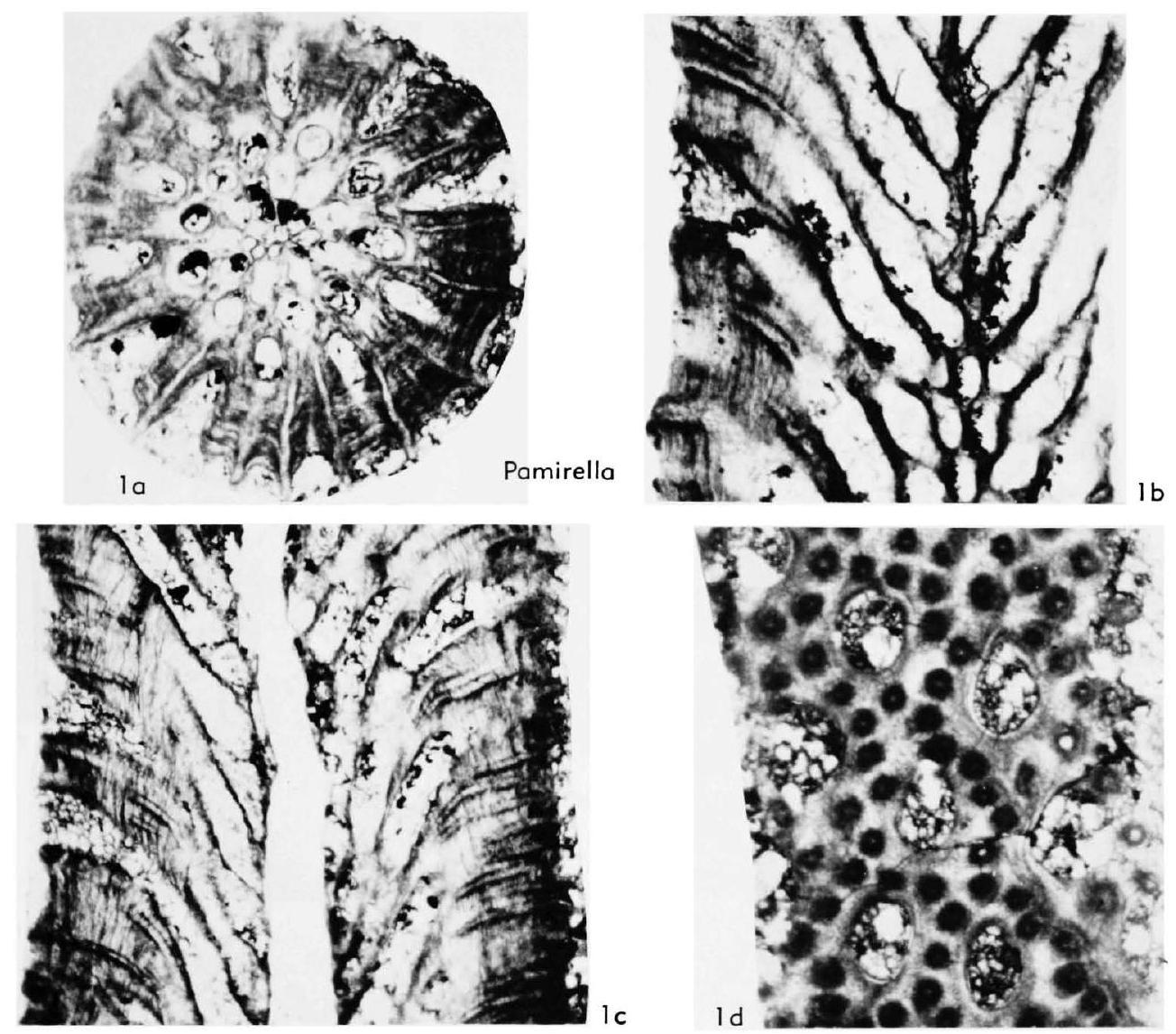 Fig. 288, 1a-d. *P. nitida, a, zooecial cross sections, stylet development, lamellar profile, transv. sec., holotype, PIN 2351/215, x25, b, branch axis, zooecial shapes, stylet development, long. sec., PIN 2351/99, x25, c, branch axis, zooecial shapes, stylet development, long. sec., holotype, x25, d, apertural and stylet arrangements, tang. sec., holotype, x40."
Synonyms
Neorhombopora
Geographic Distribution
L.Carb. (Osag.)L.Perm. (Artinsk. ), USSR, Timor, N.Am.
Age Range
Beginning Stage in Treatise Usage:
L.Carb. (Osag.)
Beginning International Stage:
Tournaisian
Fraction Up In Beginning Stage:
80.6
Beginning Date:
349.17
Ending Stage in Treatise Usage:
L.Perm. (Artinsk.)
Ending International Stage:
Artinskian
Fraction Up In Ending Stage:
100
Ending Date:
283.3
Description
Zoarium with jointing unknown; branch diamerers 0.5 to 2.5 mm, generally constant between bifurcations. Apertural arrangement rhombic. Metapores unknown. Axial region usually formed by welldefined linear axis; endozonal zooecia may parallel axis for short intervals, but true axial zooecia not developed. Zooecial bases attenuated to weakly inflated; zooecial cross sections polygonal, irregular in endozone. Zooecial divergence from axis approximately 20° to 40°. Zooecial bend rounded, living chamber outlines may be deflected by stylets,90°tchambersoriented70°to o branch surface. Zooecial length generally ranging to about 10 times diameter; longitudinal arrangement of zooecia somewhat irregular. Diaphragms may be common. Exozonal width approximately half to wo-thirds branch radius. Lamellar profile V-shaped in exozone. Acanthostyles common to abundant, filling exozone in some species, usually not aligned in well-defined series. Acanthostyles arising in exozone, parallel to zooecia; core typically large, well developed; sheath laminae commonly subparallel to core, sharply defined. LAs originally described, Pamirella included the type species and P. (ex Rhombipora) pulchra (BassLeR); it is here extended to include P. orientalis (BASSLER), P. nicklesi (ULRICH), P. minor (ULRICH), and P. asperula (ULRICH), all previously assigned to Rhombopora. Pamirella is distinguished on development of the axial region, zooecial shape and orientation, acanthostyle development, and lack of hemisepta.]
References
Museum or Author Information
Classification
Phylum:
Bryozoa
Subphylum:
Ectoprocta
Class:
Gymnolaemata
Order:
Cryptostomata
Suborder:
Rhabdomesina
Family:
Rhomboporidae
Formal Genus Name and Reference:
Pamirella Romanchuk & KISELEVA, 1968, p. 57
Type Species:
P. nitida
Images
(Click to enlarge in a new window)
Fig. 288, 1a-d. *P. nitida, a, zooecial cross sections, stylet development, lamellar profile, transv. sec., holotype, PIN 2351/215, x25, b, branch axis, zooecial shapes, stylet development, long. sec., PIN 2351/99, x25, c, branch axis, zooecial shapes, stylet development, long. sec., holotype, x25, d, apertural and stylet arrangements, tang. sec., holotype, x40."
Synonyms
Neorhombopora
Geographic Distribution
L.Carb. (Osag.)L.Perm. (Artinsk. ), USSR, Timor, N.Am.
Age Range
Beginning Stage in Treatise Usage:
L.Carb. (Osag.)
Beginning International Stage:
Tournaisian
Fraction Up In Beginning Stage:
80.6
Beginning Date:
349.17
Ending Stage in Treatise Usage:
L.Perm. (Artinsk.)
Ending International Stage:
Artinskian
Fraction Up In Ending Stage:
100
Ending Date:
283.3
Description
Zoarium with jointing unknown; branch diamerers 0.5 to 2.5 mm, generally constant between bifurcations. Apertural arrangement rhombic. Metapores unknown. Axial region usually formed by welldefined linear axis; endozonal zooecia may parallel axis for short intervals, but true axial zooecia not developed. Zooecial bases attenuated to weakly inflated; zooecial cross sections polygonal, irregular in endozone. Zooecial divergence from axis approximately 20° to 40°. Zooecial bend rounded, living chamber outlines may be deflected by stylets,90°tchambersoriented70°to o branch surface. Zooecial length generally ranging to about 10 times diameter; longitudinal arrangement of zooecia somewhat irregular. Diaphragms may be common. Exozonal width approximately half to wo-thirds branch radius. Lamellar profile V-shaped in exozone. Acanthostyles common to abundant, filling exozone in some species, usually not aligned in well-defined series. Acanthostyles arising in exozone, parallel to zooecia; core typically large, well developed; sheath laminae commonly subparallel to core, sharply defined. LAs originally described, Pamirella included the type species and P. (ex Rhombipora) pulchra (BassLeR); it is here extended to include P. orientalis (BASSLER), P. nicklesi (ULRICH), P. minor (ULRICH), and P. asperula (ULRICH), all previously assigned to Rhombopora. Pamirella is distinguished on development of the axial region, zooecial shape and orientation, acanthostyle development, and lack of hemisepta.]