
Welcome to the Bryozoa subsite on Invertebrate Paleontology!
Please enter a genera name to retrieve more information.
Insignia
Classification
Phylum:
Bryozoa
Subphylum:
Ectoprocta
Class:
Gymnolaemata
Order:
Cryptostomata
Suborder:
Ptilodictyina
Family:
Ptilodictyidae
Formal Genus Name and Reference:
Insignia ASTROVA, 1965, p. 271
Type Species:
Phaenopora insignis NEKHOROSHEV, 1961, p. 89, OD, Nishnyaya Chunka River, U. Ord., Sib., USSR
Images
(Click to enlarge in a new window)
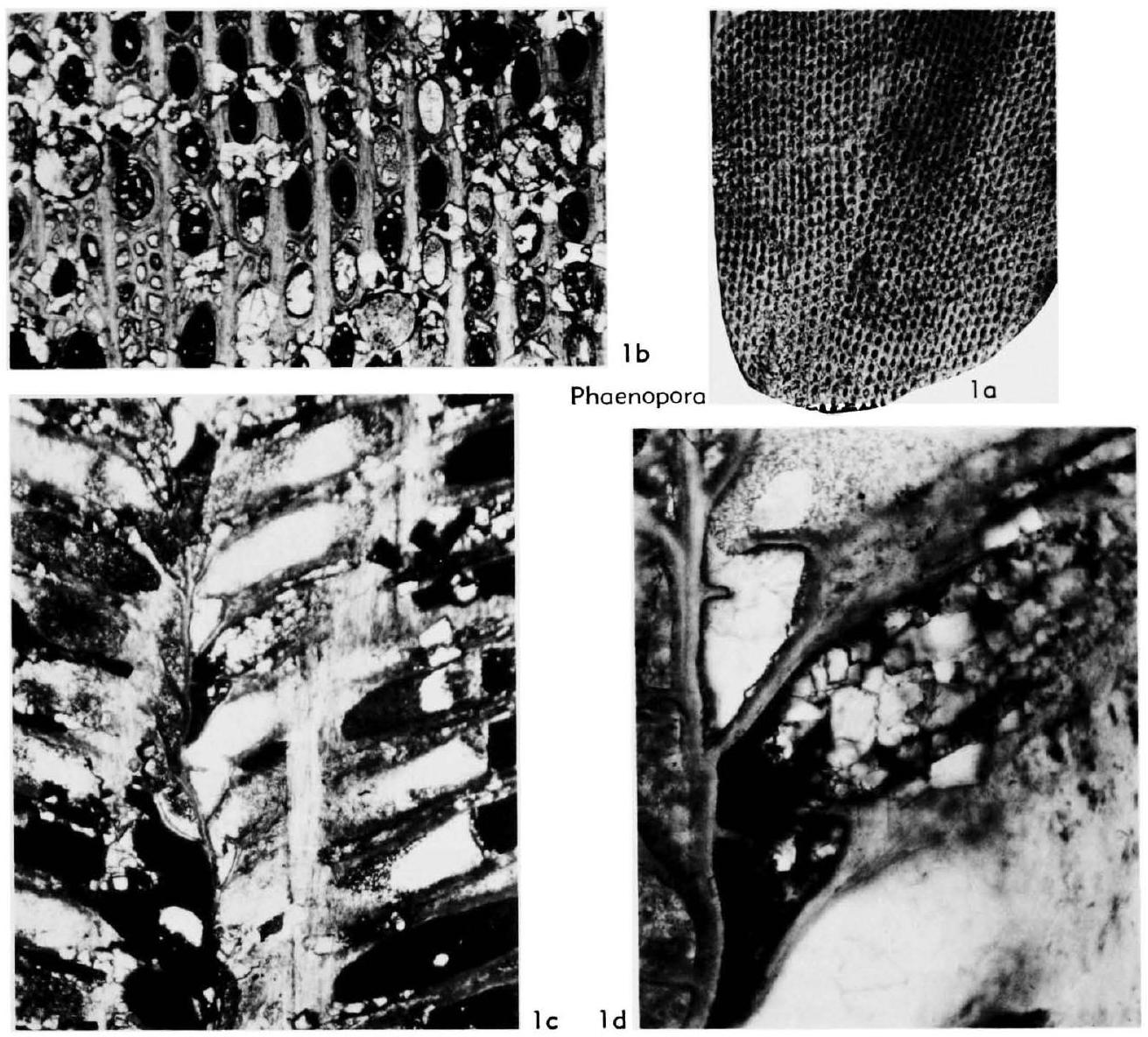 FIG. 242,2a-c. "'I. insignis (NEKHOROSHEV), Podkamennaya Tunguska River, Sib.; a, mesotheca with discontinuous median granular zone, abandoned chambers with superior hemisepta as basal diaphragms and inferior hemisepta in endozone, exilazooecial chambers at base of exozone; long. sec., PIN 1242/81, XlOO; b, living chambers with alternating hemisepta, curved transverse walls in endozone; long. sec., PIN 1242/81, X30; c, irregularly aligned ranges, monticule with larger zooecium, (upper left); tang. sec., PIN 1242/87, X30.
Synonyms
Geographic Distribution
M.Ord.-U.Sil., USSR, N.Am., Eng., Swed.
Age Range
Beginning Stage in Treatise Usage:
M.Ord.
Beginning International Stage:
Dapingian
Fraction Up In Beginning Stage:
0
Beginning Date:
471.26
Ending Stage in Treatise Usage:
U.Sil.
Ending International Stage:
Pridoli
Fraction Up In Ending Stage:
100
Ending Date:
419
Description
Zoarium branched or unbranched and subcylindrical to irregularly explanate, relatively large and variable in thickness, Unbranched zoaria subcylindrical with conical, proximal tips, Branched zoaria with approximately parallel branches and tapering proximal segments, Zoarial midregions slightly raised, subcylindrical in transverse section, tapering to flattened lateral regions, Mesothecae slightly sinuous in longitudinal section, In endozone, autozooecia in straight and variably curving ranges. In exozones, autozooecia ontogenetically subrectangular to subelliptical in cross section; in straight ranges for varying distances in zoarial midregions; in irregularly curving, converging, or bifurcating ranges in grearer parr of zoarium. Aurozooecia conriguous or separared laterally and wirhin ranges by exilazooecia, commonly replaced by groups of exilazooecia at irregular inrervals. Aurozooecial boundaries generally nor visible; pustules scattered in exozonal walls. Living chambers broadly elliptical ro subcircular in cross secrion, lining thick ro lacking. Superior and inferior hemisepta common, long, straight, relatively thick, and regularly arranged. Inferior hemisepta projecring from mesothecae or distal walls; superior hemiseprum locally a basal diaphragm in some species. Exilazooecia abundant, irregularly subcircular or varying in cross section; slighrly variable in size, commonly with narrower chambers in ourer exozones; generally arranged in irregular groups, rarely in pairs between successive autozooecia, or in one or two relatively straight rows of variable length in areas of replaced autozooecia. Monticules common, consisting of several exilazooecia and scattered zooecia in varying combinations; pustules common in walls. [Insignia is closely related to Phaenopora but differs from it in having a modified autozooecial budding pattern, in abundance and distribution of exilazooecia, in having massive zoaria, and in having unbranched zoaria of variable growth habits that probably result from the irregular autozooecial budding pattern. According to ASTROVA (1965, p. 271), variations in growth habits in Insignia do not seem to have been controlled by changes in depositional environments.]
References
Museum or Author Information
Classification
Phylum:
Bryozoa
Subphylum:
Ectoprocta
Class:
Gymnolaemata
Order:
Cryptostomata
Suborder:
Ptilodictyina
Family:
Ptilodictyidae
Formal Genus Name and Reference:
Insignia ASTROVA, 1965, p. 271
Type Species:
Phaenopora insignis NEKHOROSHEV, 1961, p. 89, OD, Nishnyaya Chunka River, U. Ord., Sib., USSR
Images
(Click to enlarge in a new window)
FIG. 242,2a-c. "'I. insignis (NEKHOROSHEV), Podkamennaya Tunguska River, Sib.; a, mesotheca with discontinuous median granular zone, abandoned chambers with superior hemisepta as basal diaphragms and inferior hemisepta in endozone, exilazooecial chambers at base of exozone; long. sec., PIN 1242/81, XlOO; b, living chambers with alternating hemisepta, curved transverse walls in endozone; long. sec., PIN 1242/81, X30; c, irregularly aligned ranges, monticule with larger zooecium, (upper left); tang. sec., PIN 1242/87, X30.
Synonyms
Geographic Distribution
M.Ord.-U.Sil., USSR, N.Am., Eng., Swed.
Age Range
Beginning Stage in Treatise Usage:
M.Ord.
Beginning International Stage:
Dapingian
Fraction Up In Beginning Stage:
0
Beginning Date:
471.26
Ending Stage in Treatise Usage:
U.Sil.
Ending International Stage:
Pridoli
Fraction Up In Ending Stage:
100
Ending Date:
419
Description
Zoarium branched or unbranched and subcylindrical to irregularly explanate, relatively large and variable in thickness, Unbranched zoaria subcylindrical with conical, proximal tips, Branched zoaria with approximately parallel branches and tapering proximal segments, Zoarial midregions slightly raised, subcylindrical in transverse section, tapering to flattened lateral regions, Mesothecae slightly sinuous in longitudinal section, In endozone, autozooecia in straight and variably curving ranges. In exozones, autozooecia ontogenetically subrectangular to subelliptical in cross section; in straight ranges for varying distances in zoarial midregions; in irregularly curving, converging, or bifurcating ranges in grearer parr of zoarium. Aurozooecia conriguous or separared laterally and wirhin ranges by exilazooecia, commonly replaced by groups of exilazooecia at irregular inrervals. Aurozooecial boundaries generally nor visible; pustules scattered in exozonal walls. Living chambers broadly elliptical ro subcircular in cross secrion, lining thick ro lacking. Superior and inferior hemisepta common, long, straight, relatively thick, and regularly arranged. Inferior hemisepta projecring from mesothecae or distal walls; superior hemiseprum locally a basal diaphragm in some species. Exilazooecia abundant, irregularly subcircular or varying in cross section; slighrly variable in size, commonly with narrower chambers in ourer exozones; generally arranged in irregular groups, rarely in pairs between successive autozooecia, or in one or two relatively straight rows of variable length in areas of replaced autozooecia. Monticules common, consisting of several exilazooecia and scattered zooecia in varying combinations; pustules common in walls. [Insignia is closely related to Phaenopora but differs from it in having a modified autozooecial budding pattern, in abundance and distribution of exilazooecia, in having massive zoaria, and in having unbranched zoaria of variable growth habits that probably result from the irregular autozooecial budding pattern. According to ASTROVA (1965, p. 271), variations in growth habits in Insignia do not seem to have been controlled by changes in depositional environments.]