
Welcome to the Bryozoa subsite on Invertebrate Paleontology!
Please enter a genera name to retrieve more information.

Helopora
Classification
Phylum:
Bryozoa
Subphylum:
Ectoprocta
Class:
Gymnolaemata
Order:
Cryptostomata
Suborder:
Rhabdomesina
Family:
Arthrostylidae
Formal Genus Name and Reference:
Helopora Hall in Silliman, Silliman, & DANA, 1851, p. 398
Type Species:
H. fragilis, M, ?Cabot Head Sh., Cataract Gr., equals Clinton Gr. of Hall, L. Sil., Flamborough Township, near ?Hamilton, Ont., Can.
Images
(Click to enlarge in a new window)
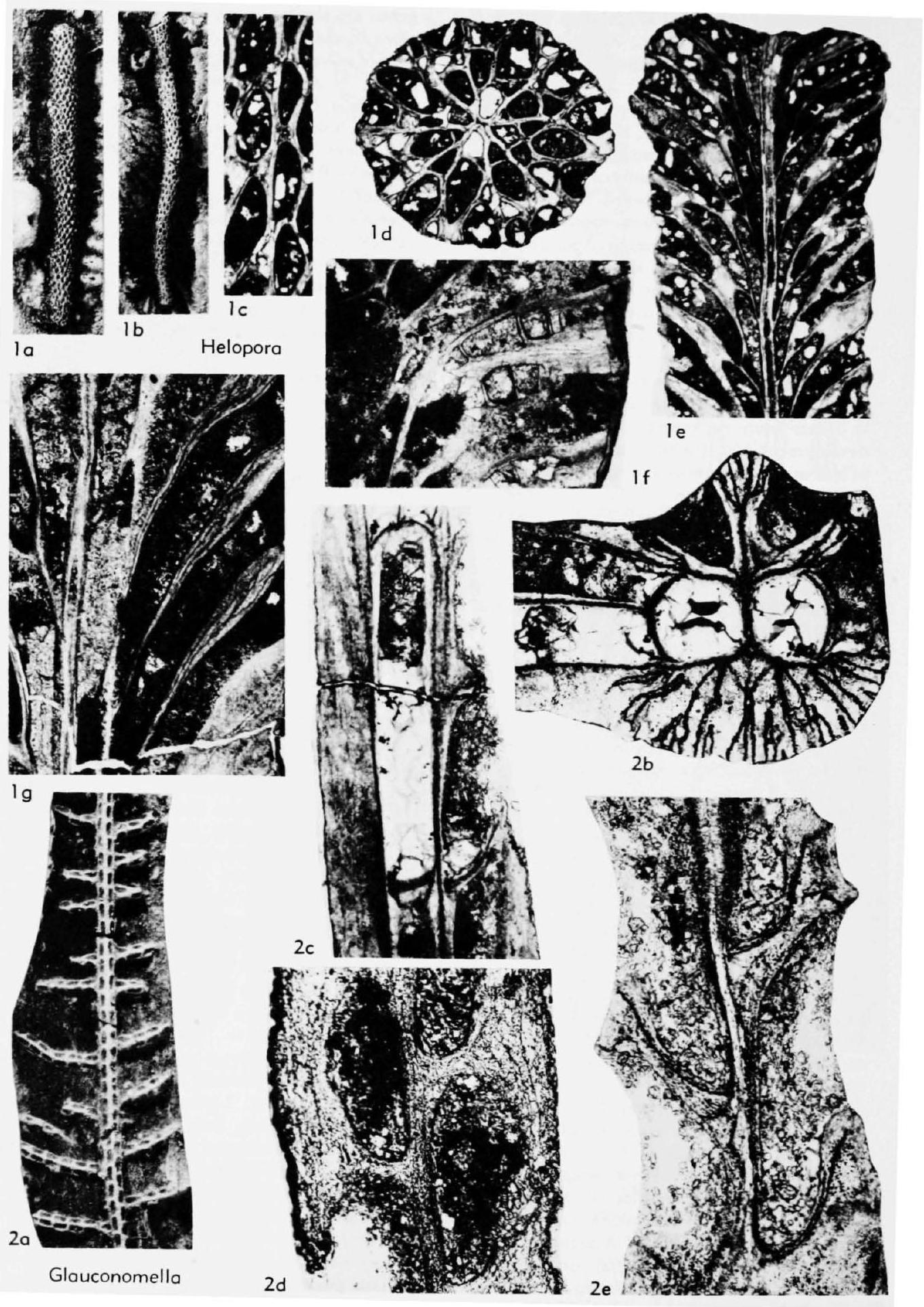 Fig. 274, 1a-g. *H. fragilis, a, b, stem shapes and apertural arrangement, syntypes, AMNH 30718, 30722, both x6, c, apertural arrangement, stylet development, deep tang. sec., USNM 240814, x50, d, zooecial and metapore cross sections, transv. sec., USNM 240814, x50, e, expanded distal end of stem, zooecial shapes, acanthostyles, long. sec., USNM 240818 x30, f, distal end of segment, metapore, long. sec., USNM 222622, x75, g, zooecial shapes and boundaries, lamellar profile, long. sec., USNM 240816, x75.
Synonyms
Geographic Distribution
E.N.Am., S.Am., USSR
Age Range
Beginning Stage in Treatise Usage:
L.Sil. (Llandov.)
Beginning International Stage:
Rhuddanian
Fraction Up In Beginning Stage:
0
Beginning Date:
443.07
Ending Stage in Treatise Usage:
L.Dev., ? M.Dev.(Eifel.), U.Dev.
Ending International Stage:
Famennian
Fraction Up In Ending Stage:
100
Ending Date:
359.3
Description
Zoarium dendroid, jointing unknown. Branches 0.55 to 0.70 mm in diameter, subcircular in cross section. Apertures in 7 ro 9 longitudinal rows, separated by ridges; metapores absent. Axial region formed by few axial zooecia. Zooecial bases attenuated to weakly inflated. Zooecial cross section in endozone polygonal, initially triangular. Zooecial divergence from axial region approximately 15 0 to 30 ; 0 zooecial bend abrupt. Living chambers oriented from 70 0 to 90 0 to branch surface. Autozooecial length generally about 10 times diameter. Longitudinal arrangement of autozooecia somewhat irregular. Proximal wall angular at zooecial bend; diaphragms rare. Exozonal width varied, generally about half branch radius. Zooecial boundaries well defined, narrow; nonlaminated material locally developed. Planar, longitudinal, dark zones radiating through exozone from approximate position of zooecial boundaries at base of exozone. Extrazooecial skeleton well developed. Lamellar profile in exozone V-shaped against dark zones. Stylets developed on longitudinal ridges between apertures. [Heloclema is distinguished by zooecial shape and orientation, arrangement of stylets, and development of the exozonal wall. It resembles Nematopora in development of the exozonal wall and arrangement of stylets.]
References
Silliman, Benjamin, Silliman, Benjamin, Jr., \& Dana, J. D., 1851, New genera of fossil corals from the report of James Hall, on the paleontology of New York: Am. J. Sci. Arts, ser. 2, v. 11, p. 398401.
Museum or Author Information
Classification
Phylum:
Bryozoa
Subphylum:
Ectoprocta
Class:
Gymnolaemata
Order:
Cryptostomata
Suborder:
Rhabdomesina
Family:
Arthrostylidae
Formal Genus Name and Reference:
Helopora Hall in Silliman, Silliman, & DANA, 1851, p. 398
Type Species:
H. fragilis, M, ?Cabot Head Sh., Cataract Gr., equals Clinton Gr. of Hall, L. Sil., Flamborough Township, near ?Hamilton, Ont., Can.
Images
(Click to enlarge in a new window)
Fig. 274, 1a-g. *H. fragilis, a, b, stem shapes and apertural arrangement, syntypes, AMNH 30718, 30722, both x6, c, apertural arrangement, stylet development, deep tang. sec., USNM 240814, x50, d, zooecial and metapore cross sections, transv. sec., USNM 240814, x50, e, expanded distal end of stem, zooecial shapes, acanthostyles, long. sec., USNM 240818 x30, f, distal end of segment, metapore, long. sec., USNM 222622, x75, g, zooecial shapes and boundaries, lamellar profile, long. sec., USNM 240816, x75.
Synonyms
Geographic Distribution
E.N.Am., S.Am., USSR
Age Range
Beginning Stage in Treatise Usage:
L.Sil. (Llandov.)
Beginning International Stage:
Rhuddanian
Fraction Up In Beginning Stage:
0
Beginning Date:
443.07
Ending Stage in Treatise Usage:
L.Dev., ? M.Dev.(Eifel.), U.Dev.
Ending International Stage:
Famennian
Fraction Up In Ending Stage:
100
Ending Date:
359.3
Description
Zoarium dendroid, jointing unknown. Branches 0.55 to 0.70 mm in diameter, subcircular in cross section. Apertures in 7 ro 9 longitudinal rows, separated by ridges; metapores absent. Axial region formed by few axial zooecia. Zooecial bases attenuated to weakly inflated. Zooecial cross section in endozone polygonal, initially triangular. Zooecial divergence from axial region approximately 15 0 to 30 ; 0 zooecial bend abrupt. Living chambers oriented from 70 0 to 90 0 to branch surface. Autozooecial length generally about 10 times diameter. Longitudinal arrangement of autozooecia somewhat irregular. Proximal wall angular at zooecial bend; diaphragms rare. Exozonal width varied, generally about half branch radius. Zooecial boundaries well defined, narrow; nonlaminated material locally developed. Planar, longitudinal, dark zones radiating through exozone from approximate position of zooecial boundaries at base of exozone. Extrazooecial skeleton well developed. Lamellar profile in exozone V-shaped against dark zones. Stylets developed on longitudinal ridges between apertures. [Heloclema is distinguished by zooecial shape and orientation, arrangement of stylets, and development of the exozonal wall. It resembles Nematopora in development of the exozonal wall and arrangement of stylets.]
References
Silliman, Benjamin, Silliman, Benjamin, Jr., \& Dana, J. D., 1851, New genera of fossil corals from the report of James Hall, on the paleontology of New York: Am. J. Sci. Arts, ser. 2, v. 11, p. 398401.