
Welcome to the Bryozoa subsite on Invertebrate Paleontology!
Please enter a genera name to retrieve more information.
Goniocladia
Classification
Phylum:
Bryozoa
Subphylum:
Ectoprocta
Class:
Gymnolaemata
Order:
Cystoporata
Suborder:
Fistuliporina
Family:
Goniocladiidae
Formal Genus Name and Reference:
Goniocladia ETHERIDGE, 1876, p. 522, nom. subst. pro Carinella ETHERIDGE, 1873, p, 433, non JOHNSTON, 1833, p. 232
Type Species:
*Carinella cellulifera ETHERIDGE, 1873, p. 433, OD, "Low. Ls. Gr., " L. Carb., Braidwood, Eng.
Images
(Click to enlarge in a new window)
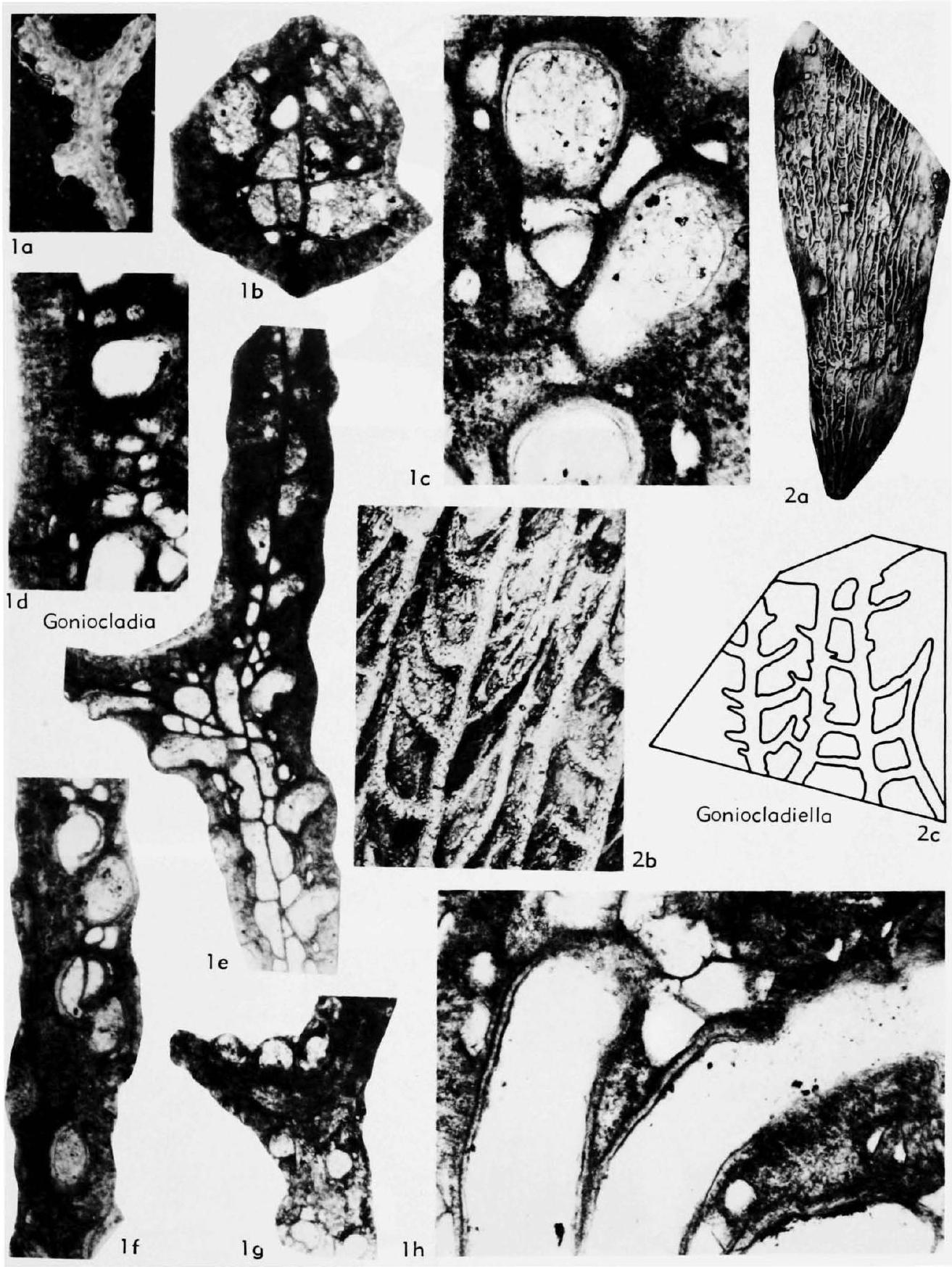 Fig. 213, 1a-b. *G. cellulifera (Etheridge), a, branching zoarium, elevated lunaria, topotype, BMNH D32637, x9, b, vertical mesotheca, vesicles and stereom in exozone, stereom on reverse side (below), transv. sec., topotype, BMNH D 32637-3, x50, c, laminated walls and lunaria with tubules on outer side (right), stereom with numerous acanthostyles, tang. sec., topotype, BMNH D32637-2, x100, d, solid reverse side (left), autozooecia and vesicles in endozone, oblique long. sec., topotype, BMNH D326377, x50, e, mesotheca, autozooecia curve distolaterally, vesicles in outer endozone, stereom in exozone, tang. sec., topotype, BMNH D326375, x30, f, mesotheca (left), autozooecia isolated by stereom and vesicles, lunaria on outer (right) side, tang. sec., topotype, BMNH D32637-4, x50, g, subcircular autozooecia, tang. sec., topotype, BMNH D32637-7, x30, b, wall microstructure, vesicles and stereom, long. sec., topotype, BMNH D32637-7, x100."
Synonyms
Geographic Distribution
Miss.-Perm., Eu., Asia, Australia
Age Range
Beginning Stage in Treatise Usage:
Miss.
Beginning International Stage:
Tournaisian
Fraction Up In Beginning Stage:
0
Beginning Date:
359.3
Ending Stage in Treatise Usage:
Perm.
Ending International Stage:
Changhsingian
Fraction Up In Ending Stage:
100
Ending Date:
251.9
Description
Zoarium bifoliate, narrow, curved dichotomous branches in some anastomosing to form large fenestrules, vertical mesotheca protruding as ridge on rounded, noncelluliferous reverse side and as sharp keel on peaked obverse side, Autozooecia in two to three rows on either side of median carina, subcircular apertures opening upward and indented by ends of lunaria on side of autozooecia away from branch center, Mesotheca thin, median layer dark, outer layers laminated, Autozooecia hemispherical in cross section at mesotheca, partially isolated by small vesicles, curving upward and outward, diaphragms sparse, Walls with thin, dark, serrated boundary and laminated cortex having minute tubules perpendicular to boundary, Lunaria laminated, with numerous tubules in proximal side, Vesicles forming small blisters, laminated, stereom laminated, with numerous tubules and small, indistinct acanthostyles in most of exozone and noncelluliferous reverse side.
References
Etheridge, Robert, Jr., ,, 1876, Carboniferous and post-Tertiary Polyzoa: Geol. Mag., n.ser., dec. 2, v. 3, p. 522523, 1 text-fig.
Museum or Author Information
Classification
Phylum:
Bryozoa
Subphylum:
Ectoprocta
Class:
Gymnolaemata
Order:
Cystoporata
Suborder:
Fistuliporina
Family:
Goniocladiidae
Formal Genus Name and Reference:
Goniocladia ETHERIDGE, 1876, p. 522, nom. subst. pro Carinella ETHERIDGE, 1873, p, 433, non JOHNSTON, 1833, p. 232
Type Species:
*Carinella cellulifera ETHERIDGE, 1873, p. 433, OD, "Low. Ls. Gr., " L. Carb., Braidwood, Eng.
Images
(Click to enlarge in a new window)
Fig. 213, 1a-b. *G. cellulifera (Etheridge), a, branching zoarium, elevated lunaria, topotype, BMNH D32637, x9, b, vertical mesotheca, vesicles and stereom in exozone, stereom on reverse side (below), transv. sec., topotype, BMNH D 32637-3, x50, c, laminated walls and lunaria with tubules on outer side (right), stereom with numerous acanthostyles, tang. sec., topotype, BMNH D32637-2, x100, d, solid reverse side (left), autozooecia and vesicles in endozone, oblique long. sec., topotype, BMNH D326377, x50, e, mesotheca, autozooecia curve distolaterally, vesicles in outer endozone, stereom in exozone, tang. sec., topotype, BMNH D326375, x30, f, mesotheca (left), autozooecia isolated by stereom and vesicles, lunaria on outer (right) side, tang. sec., topotype, BMNH D32637-4, x50, g, subcircular autozooecia, tang. sec., topotype, BMNH D32637-7, x30, b, wall microstructure, vesicles and stereom, long. sec., topotype, BMNH D32637-7, x100."
Synonyms
Geographic Distribution
Miss.-Perm., Eu., Asia, Australia
Age Range
Beginning Stage in Treatise Usage:
Miss.
Beginning International Stage:
Tournaisian
Fraction Up In Beginning Stage:
0
Beginning Date:
359.3
Ending Stage in Treatise Usage:
Perm.
Ending International Stage:
Changhsingian
Fraction Up In Ending Stage:
100
Ending Date:
251.9
Description
Zoarium bifoliate, narrow, curved dichotomous branches in some anastomosing to form large fenestrules, vertical mesotheca protruding as ridge on rounded, noncelluliferous reverse side and as sharp keel on peaked obverse side, Autozooecia in two to three rows on either side of median carina, subcircular apertures opening upward and indented by ends of lunaria on side of autozooecia away from branch center, Mesotheca thin, median layer dark, outer layers laminated, Autozooecia hemispherical in cross section at mesotheca, partially isolated by small vesicles, curving upward and outward, diaphragms sparse, Walls with thin, dark, serrated boundary and laminated cortex having minute tubules perpendicular to boundary, Lunaria laminated, with numerous tubules in proximal side, Vesicles forming small blisters, laminated, stereom laminated, with numerous tubules and small, indistinct acanthostyles in most of exozone and noncelluliferous reverse side.
References
Etheridge, Robert, Jr., ,, 1876, Carboniferous and post-Tertiary Polyzoa: Geol. Mag., n.ser., dec. 2, v. 3, p. 522523, 1 text-fig.