
Welcome to the Bryozoa subsite on Invertebrate Paleontology!
Please enter a genera name to retrieve more information.

Fistulotrypa
Classification
Phylum:
Bryozoa
Subphylum:
Ectoprocta
Class:
Gymnolaemata
Order:
Cystoporata
Suborder:
Fistuliporina
Family:
Fistuliporidae
Formal Genus Name and Reference:
Fistulotrypa BASSLER, 1929, p. 48
Type Species:
F. ramosa, OD, Perm., Basleo, Timor
Images
(Click to enlarge in a new window)
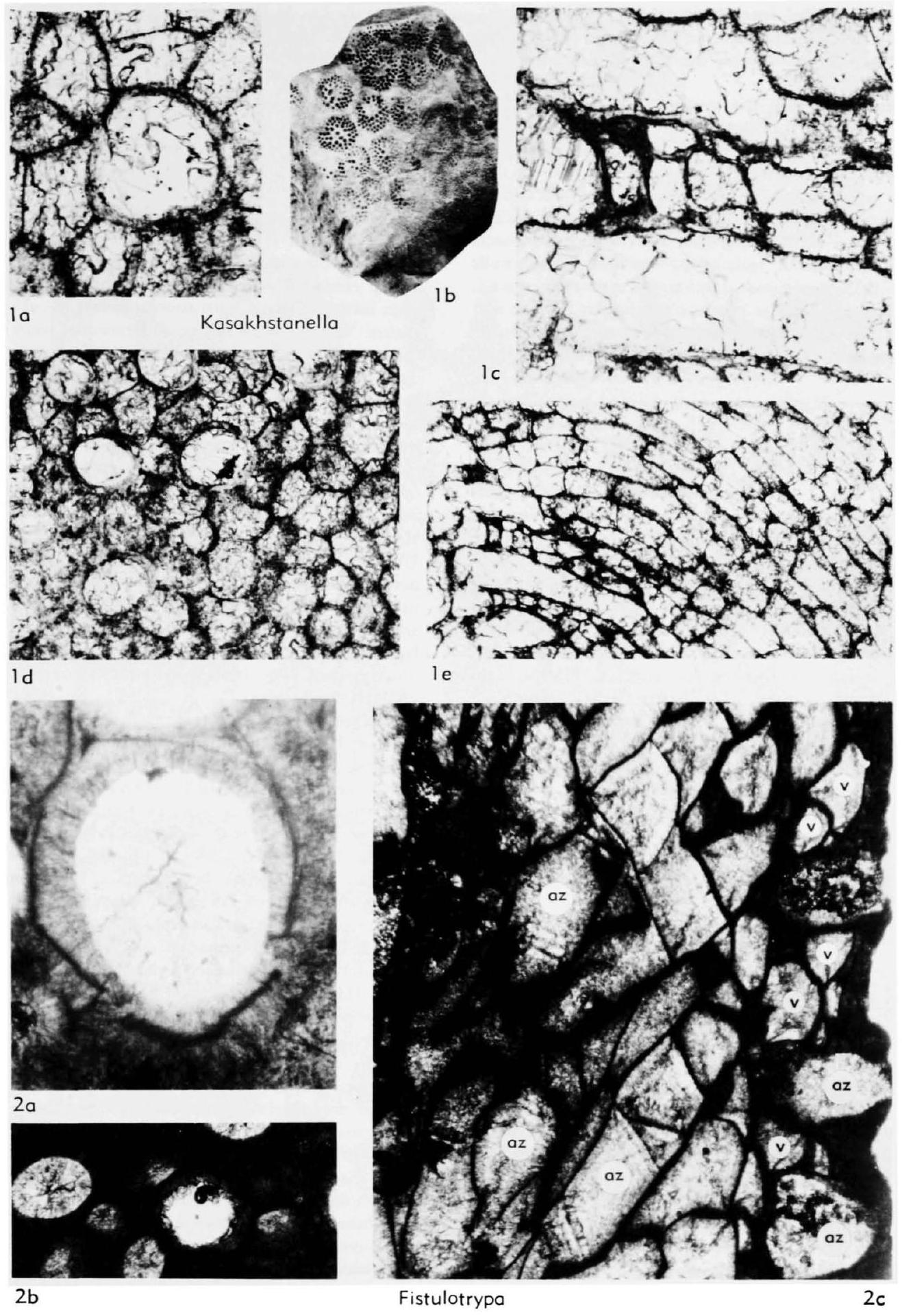 Fig. 187, 2a-c. *F. ramosa, type, USNM 159822, a, dark granular boundary, granular-prismatic cortex and lunarium (lower side) in autozooecium, tang. sec., x100, b, dark granular zooecial boundaries and subcircular vesicles, tang. sec., x30, c, large, thin-walled autozooecia (az) in endozone (left), thicker-walled autozooecia (az) and vesicular tissue (v) in exozone (right), oblique long. sec., x30.
Synonyms
Geographic Distribution
Timor
Age Range
Beginning Stage in Treatise Usage:
Perm.
Beginning International Stage:
Asselian
Fraction Up In Beginning Stage:
0
Beginning Date:
298.89
Ending Stage in Treatise Usage:
Perm.
Ending International Stage:
Changhsingian
Fraction Up In Ending Stage:
100
Ending Date:
251.9
Description
Zoarium ramose, monticules flush, center of stereom, peristomes elevated. Autozooecia in endozone contiguous, walls thin, granular, diaphragms few. Autozooecia in exozone isolated by vesicles, oval in cross section, diaphragms closely spaced. Wall with dark, granular, boundary zone and thick, gran-ular-prismatic cortex. Lunaria in exozone, inconspicuous, dark, granular zone commonly not continuous into dark, zooecial boundary, distal granular-prismatic zone thick. Vesicles in outer endozone and exozone, low, broad blisters, large and subangular in tangential view, decreasing in height outward, stereom at surface, granularprismatic structure with tubuli in vesicle roofs and stereom.
References
Bassler, R. S., ,, , 1929, The Permian Bryozoa of Timor: Paläontologie von Timor, Lief. 16, no. 28, p. 36-89, pl. 225-247 (Stuttgart).
Museum or Author Information
Classification
Phylum:
Bryozoa
Subphylum:
Ectoprocta
Class:
Gymnolaemata
Order:
Cystoporata
Suborder:
Fistuliporina
Family:
Fistuliporidae
Formal Genus Name and Reference:
Fistulotrypa BASSLER, 1929, p. 48
Type Species:
F. ramosa, OD, Perm., Basleo, Timor
Images
(Click to enlarge in a new window)
Fig. 187, 2a-c. *F. ramosa, type, USNM 159822, a, dark granular boundary, granular-prismatic cortex and lunarium (lower side) in autozooecium, tang. sec., x100, b, dark granular zooecial boundaries and subcircular vesicles, tang. sec., x30, c, large, thin-walled autozooecia (az) in endozone (left), thicker-walled autozooecia (az) and vesicular tissue (v) in exozone (right), oblique long. sec., x30.
Synonyms
Geographic Distribution
Timor
Age Range
Beginning Stage in Treatise Usage:
Perm.
Beginning International Stage:
Asselian
Fraction Up In Beginning Stage:
0
Beginning Date:
298.89
Ending Stage in Treatise Usage:
Perm.
Ending International Stage:
Changhsingian
Fraction Up In Ending Stage:
100
Ending Date:
251.9
Description
Zoarium ramose, monticules flush, center of stereom, peristomes elevated. Autozooecia in endozone contiguous, walls thin, granular, diaphragms few. Autozooecia in exozone isolated by vesicles, oval in cross section, diaphragms closely spaced. Wall with dark, granular, boundary zone and thick, gran-ular-prismatic cortex. Lunaria in exozone, inconspicuous, dark, granular zone commonly not continuous into dark, zooecial boundary, distal granular-prismatic zone thick. Vesicles in outer endozone and exozone, low, broad blisters, large and subangular in tangential view, decreasing in height outward, stereom at surface, granularprismatic structure with tubuli in vesicle roofs and stereom.
References
Bassler, R. S., ,, , 1929, The Permian Bryozoa of Timor: Paläontologie von Timor, Lief. 16, no. 28, p. 36-89, pl. 225-247 (Stuttgart).