
Welcome to the Bryozoa subsite on Invertebrate Paleontology!
Please enter a genera name to retrieve more information.

Fistuliramus
Classification
Phylum:
Bryozoa
Subphylum:
Ectoprocta
Class:
Gymnolaemata
Order:
Cystoporata
Suborder:
Fistuliporina
Family:
Fistuliporidae
Formal Genus Name and Reference:
Fistuliramus ASTROVA, 1960b, p. 362
Type Species:
F. sinensis, OD, U. Sil., Arctic Urals, USSR
Images
(Click to enlarge in a new window)
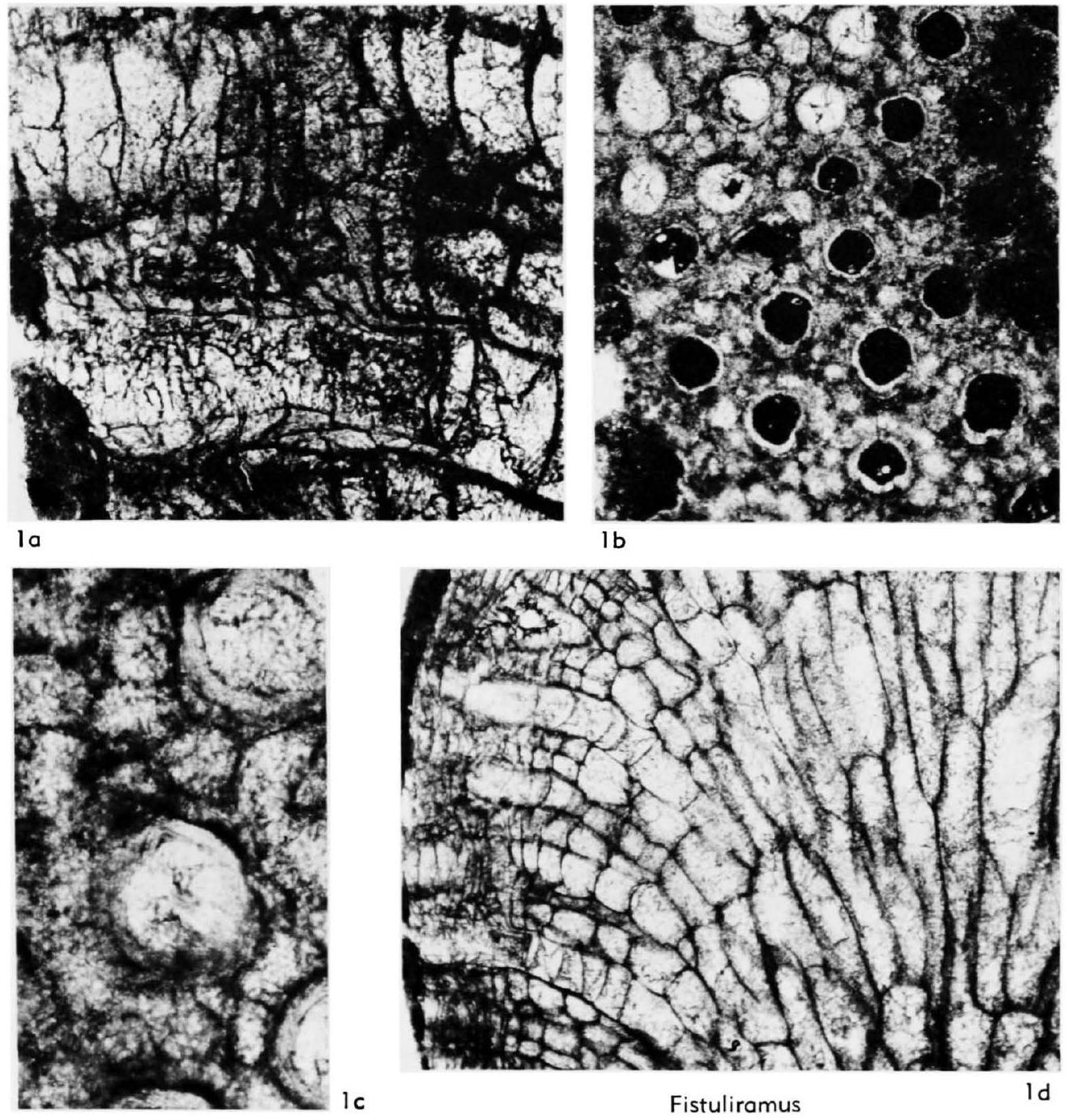 Fig. 185, 1ad. * F. sinensis, paratype, PIN 124-7/32, a, autozooecium with closely spaced diaphragms and laminated lining with tubules in living chamber (below, left), low, blisterlike vesicles with zone of thicker roofs (above, center), long. sec., x100, b, autozooecia with light-colored lining and hyaline lunaria isolated by small subcircular vesicles, tang. sec., x30, c, laminated autozooecial lining, light-colored lunaria, and small vesicles, tang. sec., x100, d, thin-walled autozooecia and long, blisterlike vesicles in endozone (right), closely spaced diaphragms in inner exozone and decrease in vesicle height in exozone, long. sec., x30.
Synonyms
Geographic Distribution
USSR
Age Range
Beginning Stage in Treatise Usage:
U.Sil.
Beginning International Stage:
Gorstian
Fraction Up In Beginning Stage:
0
Beginning Date:
426.74
Ending Stage in Treatise Usage:
L.Dev.
Ending International Stage:
Emsian
Fraction Up In Ending Stage:
100
Ending Date:
394.3
Description
Zoarium ramose. Monticules with ring of larger zooecia, lunaria in part radially arranged. Autozooecia thin-walled in endozone, isolated by vesicular tissue, subcircular in cross section in exozone, narrowly isolated by vesicles, walls laminated, thick laminated lining in exozone, some mural tubuli in lining. Diaphragms closely spaced in outer endozone and exozone, thin, flat to concave. Lunaria in outer endozone and exozone, of light-colored and dense calcite. Vesicular tissue long blisters in endozone, becoming more subquadrate at zooecial-bend region, decreasing in height outward in exozone, walls and roofs laminated, containing small acanthostyles or tubuli.
References
Museum or Author Information
Classification
Phylum:
Bryozoa
Subphylum:
Ectoprocta
Class:
Gymnolaemata
Order:
Cystoporata
Suborder:
Fistuliporina
Family:
Fistuliporidae
Formal Genus Name and Reference:
Fistuliramus ASTROVA, 1960b, p. 362
Type Species:
F. sinensis, OD, U. Sil., Arctic Urals, USSR
Images
(Click to enlarge in a new window)
Fig. 185, 1ad. * F. sinensis, paratype, PIN 124-7/32, a, autozooecium with closely spaced diaphragms and laminated lining with tubules in living chamber (below, left), low, blisterlike vesicles with zone of thicker roofs (above, center), long. sec., x100, b, autozooecia with light-colored lining and hyaline lunaria isolated by small subcircular vesicles, tang. sec., x30, c, laminated autozooecial lining, light-colored lunaria, and small vesicles, tang. sec., x100, d, thin-walled autozooecia and long, blisterlike vesicles in endozone (right), closely spaced diaphragms in inner exozone and decrease in vesicle height in exozone, long. sec., x30.
Synonyms
Geographic Distribution
USSR
Age Range
Beginning Stage in Treatise Usage:
U.Sil.
Beginning International Stage:
Gorstian
Fraction Up In Beginning Stage:
0
Beginning Date:
426.74
Ending Stage in Treatise Usage:
L.Dev.
Ending International Stage:
Emsian
Fraction Up In Ending Stage:
100
Ending Date:
394.3
Description
Zoarium ramose. Monticules with ring of larger zooecia, lunaria in part radially arranged. Autozooecia thin-walled in endozone, isolated by vesicular tissue, subcircular in cross section in exozone, narrowly isolated by vesicles, walls laminated, thick laminated lining in exozone, some mural tubuli in lining. Diaphragms closely spaced in outer endozone and exozone, thin, flat to concave. Lunaria in outer endozone and exozone, of light-colored and dense calcite. Vesicular tissue long blisters in endozone, becoming more subquadrate at zooecial-bend region, decreasing in height outward in exozone, walls and roofs laminated, containing small acanthostyles or tubuli.