
Welcome to the Bryozoa subsite on Invertebrate Paleontology!
Please enter a genera name to retrieve more information.

Fistulipora
Classification
Phylum:
Bryozoa
Subphylum:
Ectoprocta
Class:
Gymnolaemata
Order:
Cystoporata
Suborder:
Fistuliporina
Family:
Fistuliporidae
Formal Genus Name and Reference:
Fistulipora McCOY, 1849, p. 130, nom, conserv, ICZN Opinion 459, non RAFINESQUE, 1831
Type Species:
F, minor; SD MILNE-EDWARDS & HAIME, 1850, p. lix, non CUMINGS, 1906, p. 1293, ut F. spergensis minor; 1. Carbo Ls., Miss., G. Brit ,
Images
(Click to enlarge in a new window)
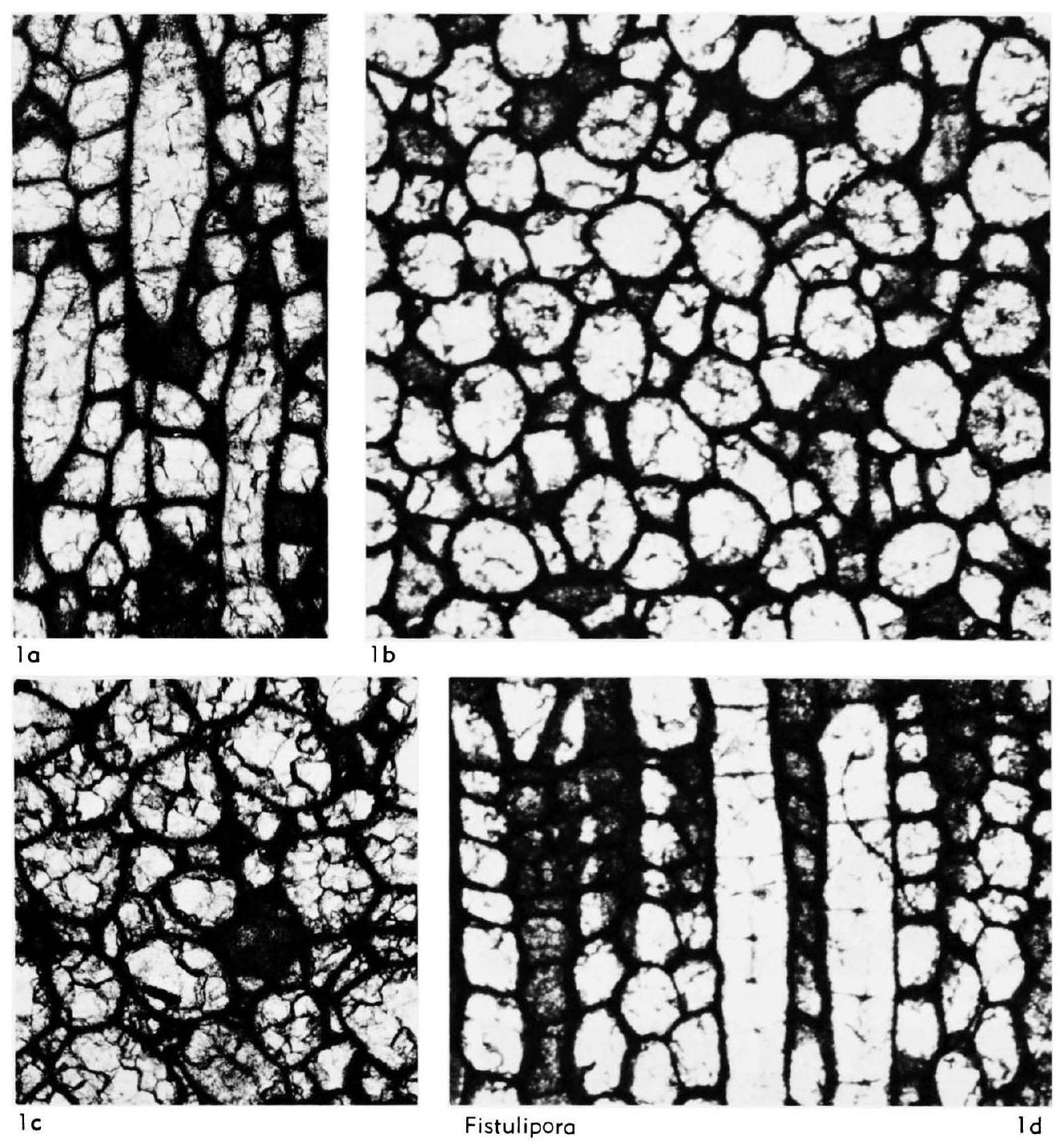 Fig. 173, la-d. *F. minor, paratype, SM 315, a, angular to blisterlike vesicles and closely spaced diaphragms in autozooecia in outer exozone, granular to granular-prismatic microstructure, transv. sec., x30, b, lunaria with short radius of curvature and granular microstructure in rounded autozooecia partially isolated by moderately large polygonal vesicles, tang. sec., x30, c, subangular autozooecia with lunaria, partially isolated by polygonal vesicles in endozone; transv. sec., X30; d, tubular autozooecia with closely spaced planar diaphragms isolared by boxlike to polygonal vesicles; long. sec., X30 (a and c are photographs of a section figured by BASSLER, labeled SM 315; band d are photo- graphs furnished by A. G. BRIGHTON of presum- ably the same paratype, SM 315, W. Hopkins ColI., bearing the additional number E53 73b).
Synonyms
Cucumulites
Geographic Distribution
worldwide
Age Range
Beginning Stage in Treatise Usage:
Sil.
Beginning International Stage:
Rhuddanian
Fraction Up In Beginning Stage:
0
Beginning Date:
443.07
Ending Stage in Treatise Usage:
Perm.
Ending International Stage:
Changhsingian
Fraction Up In Ending Stage:
100
Ending Date:
251.9
Description
Zoarium encrusting or massive, rarely ramose. Monticules elevated or flush, central cluster of vesicles and ring of larger zooecia with lunaria pardy to altogether radially arranged, on side of zooecia nearest monticular center. Autozooecia long, tubular, with closely spaced planar or curved diaphragms; parrially to completely isolated by vesicular tissue; micro- structure granular or granular-prismatic. Lunaria through endozone and exozone, granular or gran- ular-prismatic; radius of curvature shorter than that of autozooecial wall. Vesicles moderately large, angular; thin granular or granular-pris- matic walls and roofs; rarely boxlike, commonly polygonal or subquadrate blisters. Local zone of thicker vesicle roofs at zoarial surface. (Many species in this large genus are in need of restudy. Early species tend to have larger, more boxlike vesicles, whereas many late Paleozoic species have smaller, polygonal or cystlike vesicles. Cucumulites tuberculatus GURLEY, 1884 is the type species of Cucumulites GURLEY, 1884, by original designation. The holotype is silicified and has not been sectioned, Its apparent syn- onym, C. triearinatus GURLEY, 1884, though mostly silicified and poorly known, has features that are most similar to those of Fistulipora, and Cueumulites is tentatively placed in synonymy with Fistulipora.}
References
McCoy, Frederick, 1849, On some new genera and species of Palaeozoic corals and Foraminifera: Ann. Mag. Nat. Hist., ser. 2, v. 3, p. 119-136, 6 textfig.
Museum or Author Information
Classification
Phylum:
Bryozoa
Subphylum:
Ectoprocta
Class:
Gymnolaemata
Order:
Cystoporata
Suborder:
Fistuliporina
Family:
Fistuliporidae
Formal Genus Name and Reference:
Fistulipora McCOY, 1849, p. 130, nom, conserv, ICZN Opinion 459, non RAFINESQUE, 1831
Type Species:
F, minor; SD MILNE-EDWARDS & HAIME, 1850, p. lix, non CUMINGS, 1906, p. 1293, ut F. spergensis minor; 1. Carbo Ls., Miss., G. Brit ,
Images
(Click to enlarge in a new window)
Fig. 173, la-d. *F. minor, paratype, SM 315, a, angular to blisterlike vesicles and closely spaced diaphragms in autozooecia in outer exozone, granular to granular-prismatic microstructure, transv. sec., x30, b, lunaria with short radius of curvature and granular microstructure in rounded autozooecia partially isolated by moderately large polygonal vesicles, tang. sec., x30, c, subangular autozooecia with lunaria, partially isolated by polygonal vesicles in endozone; transv. sec., X30; d, tubular autozooecia with closely spaced planar diaphragms isolared by boxlike to polygonal vesicles; long. sec., X30 (a and c are photographs of a section figured by BASSLER, labeled SM 315; band d are photo- graphs furnished by A. G. BRIGHTON of presum- ably the same paratype, SM 315, W. Hopkins ColI., bearing the additional number E53 73b).
Synonyms
Cucumulites
Geographic Distribution
worldwide
Age Range
Beginning Stage in Treatise Usage:
Sil.
Beginning International Stage:
Rhuddanian
Fraction Up In Beginning Stage:
0
Beginning Date:
443.07
Ending Stage in Treatise Usage:
Perm.
Ending International Stage:
Changhsingian
Fraction Up In Ending Stage:
100
Ending Date:
251.9
Description
Zoarium encrusting or massive, rarely ramose. Monticules elevated or flush, central cluster of vesicles and ring of larger zooecia with lunaria pardy to altogether radially arranged, on side of zooecia nearest monticular center. Autozooecia long, tubular, with closely spaced planar or curved diaphragms; parrially to completely isolated by vesicular tissue; micro- structure granular or granular-prismatic. Lunaria through endozone and exozone, granular or gran- ular-prismatic; radius of curvature shorter than that of autozooecial wall. Vesicles moderately large, angular; thin granular or granular-pris- matic walls and roofs; rarely boxlike, commonly polygonal or subquadrate blisters. Local zone of thicker vesicle roofs at zoarial surface. (Many species in this large genus are in need of restudy. Early species tend to have larger, more boxlike vesicles, whereas many late Paleozoic species have smaller, polygonal or cystlike vesicles. Cucumulites tuberculatus GURLEY, 1884 is the type species of Cucumulites GURLEY, 1884, by original designation. The holotype is silicified and has not been sectioned, Its apparent syn- onym, C. triearinatus GURLEY, 1884, though mostly silicified and poorly known, has features that are most similar to those of Fistulipora, and Cueumulites is tentatively placed in synonymy with Fistulipora.}
References
McCoy, Frederick, 1849, On some new genera and species of Palaeozoic corals and Foraminifera: Ann. Mag. Nat. Hist., ser. 2, v. 3, p. 119-136, 6 textfig.