
Welcome to the Bryozoa subsite on Invertebrate Paleontology!
Please enter a genera name to retrieve more information.

Cystiramus
Classification
Phylum:
Bryozoa
Subphylum:
Ectoprocta
Class:
Gymnolaemata
Order:
Cystoporata
Suborder:
Fistuliporina
Family:
Fistuliporidae
Formal Genus Name and Reference:
Cystiramus MOROZOVA, 1959a, p. 79
Type Species:
C. kondomensis, OD
Images
(Click to enlarge in a new window)
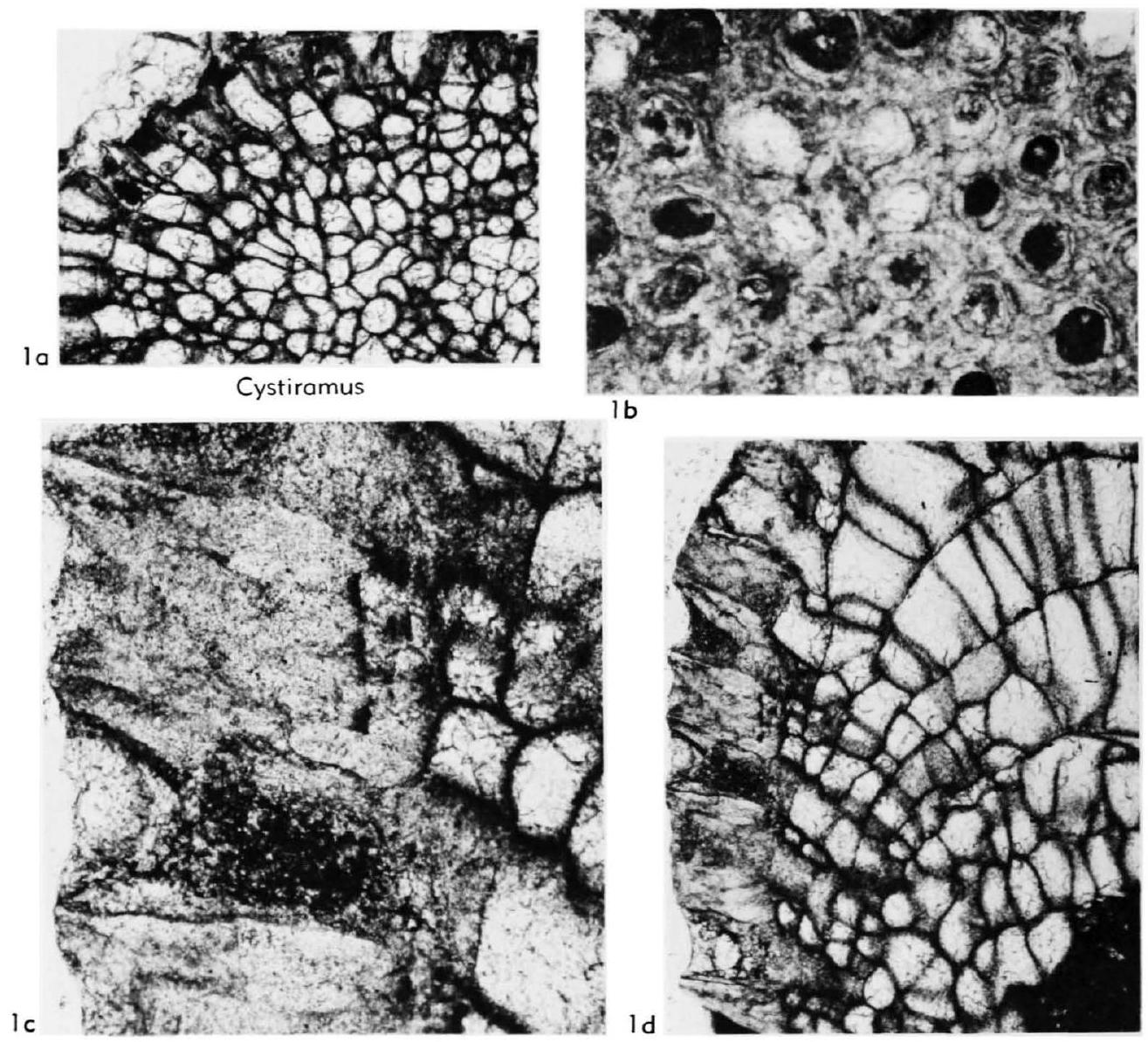 Fig. 178, 1 a-d. *C. kondomensis, a, endozonal zooecia with curved proximal side and subangular distal side, autozooecia with diaphragms isolated by vesicular tissue in exozone; transv. sec., paratype, PIN 198/12, X20; b, dark boundaries in subcircular autozooecia with lunaria of same radius of curvature on right side, stereom (with ?tubuli) isolates autozooecia; tang. sec., paralectotype, PIN 918/316a, X30; c, thick granular-prismatic walls in autozooecia isolated by boxlike vesicles and stereom in exozone; long. sec., paralectotype, PIN 918/317B, X100; d, hemispherical cycles of thin-walled autozooecia in endozone; vesicular tissue and thick-walled autozooecia in exozone; long. sec., paralectotype, PIN 918/317B, X30.
Synonyms
Geographic Distribution
USSR
Age Range
Beginning Stage in Treatise Usage:
U.Dev.
Beginning International Stage:
Frasnian
Fraction Up In Beginning Stage:
0
Beginning Date:
378.9
Ending Stage in Treatise Usage:
U.Dev.
Ending International Stage:
Famennian
Fraction Up In Ending Stage:
100
Ending Date:
359.3
Description
Zoarium ramose, bifurcating, Monticules not reported but small areas of larger zooecia are present, Endozone with short zooecia, rounded proximal side and angular distal side, cyclically budded in hemispherical zones on a curved wall, wall granular, Autozooecia in exozone isolated by vesicular tissue, wall thickening rapidly in inner exozone, boundary granular and granular-prismatic cortex thick with some distally diverging tubuli, diaphragms in inner exozone, Lunaria in exozone, dark boundary zone continuing into lateral autozooecial walls, proximal, light-colored, granular-prismatic layer thickest, with some perpendicular tubuli, Vesicles in exozone, granular-prismatic, subquadrate blisters thickened to stereom through most of exozone, ?tubuli few.
References
Museum or Author Information
Classification
Phylum:
Bryozoa
Subphylum:
Ectoprocta
Class:
Gymnolaemata
Order:
Cystoporata
Suborder:
Fistuliporina
Family:
Fistuliporidae
Formal Genus Name and Reference:
Cystiramus MOROZOVA, 1959a, p. 79
Type Species:
C. kondomensis, OD
Images
(Click to enlarge in a new window)
Fig. 178, 1 a-d. *C. kondomensis, a, endozonal zooecia with curved proximal side and subangular distal side, autozooecia with diaphragms isolated by vesicular tissue in exozone; transv. sec., paratype, PIN 198/12, X20; b, dark boundaries in subcircular autozooecia with lunaria of same radius of curvature on right side, stereom (with ?tubuli) isolates autozooecia; tang. sec., paralectotype, PIN 918/316a, X30; c, thick granular-prismatic walls in autozooecia isolated by boxlike vesicles and stereom in exozone; long. sec., paralectotype, PIN 918/317B, X100; d, hemispherical cycles of thin-walled autozooecia in endozone; vesicular tissue and thick-walled autozooecia in exozone; long. sec., paralectotype, PIN 918/317B, X30.
Synonyms
Geographic Distribution
USSR
Age Range
Beginning Stage in Treatise Usage:
U.Dev.
Beginning International Stage:
Frasnian
Fraction Up In Beginning Stage:
0
Beginning Date:
378.9
Ending Stage in Treatise Usage:
U.Dev.
Ending International Stage:
Famennian
Fraction Up In Ending Stage:
100
Ending Date:
359.3
Description
Zoarium ramose, bifurcating, Monticules not reported but small areas of larger zooecia are present, Endozone with short zooecia, rounded proximal side and angular distal side, cyclically budded in hemispherical zones on a curved wall, wall granular, Autozooecia in exozone isolated by vesicular tissue, wall thickening rapidly in inner exozone, boundary granular and granular-prismatic cortex thick with some distally diverging tubuli, diaphragms in inner exozone, Lunaria in exozone, dark boundary zone continuing into lateral autozooecial walls, proximal, light-colored, granular-prismatic layer thickest, with some perpendicular tubuli, Vesicles in exozone, granular-prismatic, subquadrate blisters thickened to stereom through most of exozone, ?tubuli few.