
Welcome to the Bryozoa subsite on Invertebrate Paleontology!
Please enter a genera name to retrieve more information.
Ceramopora
Classification
Phylum:
Bryozoa
Subphylum:
Ectoprocta
Class:
Gymnolaemata
Order:
Cystoporata
Suborder:
Ceramoporina
Family:
Ceramoporidae
Formal Genus Name and Reference:
Ceramopora Hall in Sillman, Sillman, & DANA, 1851, p. 400
Type Species:
C. imbricata Hall, 1852, p. 169, SD Hall & SIMPSON, 1887, p. xviii, Niagaran Gr., M. Sil. (Niag.), Lockport, N.Y., USA
Images
(Click to enlarge in a new window)
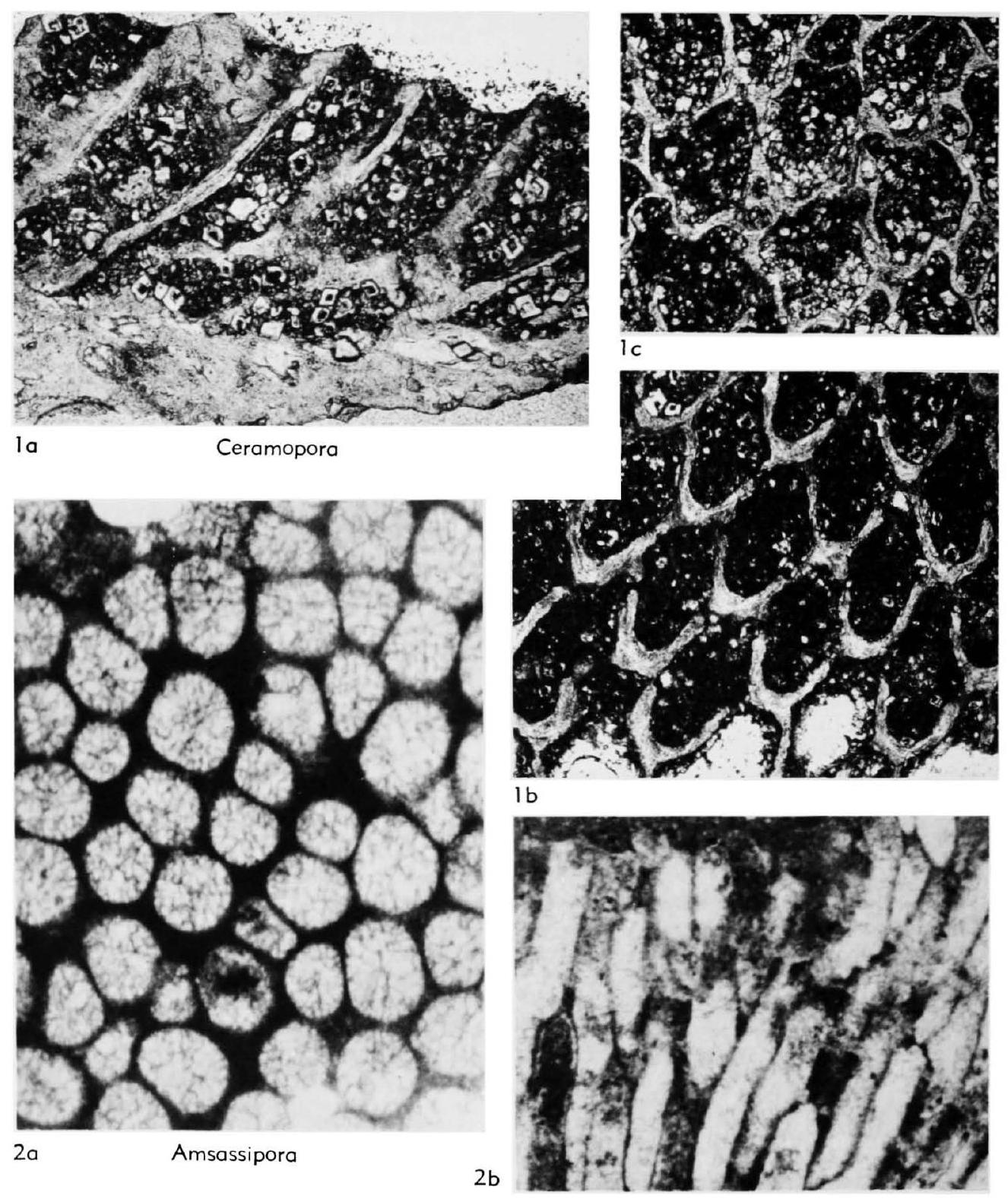 Fig. 156, 1a-c. *C. imbricata, a, celluliferous base (below), zooecial walls, lunarial deposits, and no diaphragms, long. sec., lectotype, AMNH 1737-A, x30, 6, rhombic arrangement of large ovate autozooecia, large lunarial deposits in proximal (lower) half of zooecia, abundant communication pores, and virtual absence of exilazooecia, tang. sec., lectotype, x30, c, abundant communication pores and small, subcircular exilazooecia in intermonticular area, tang. sec., paralectotype, AMNH 1737-B, x30."
Synonyms
Geographic Distribution
N.Am., Eu.
Age Range
Beginning Stage in Treatise Usage:
U .Ord. (Richmond.)
Beginning International Stage:
Katian
Fraction Up In Beginning Stage:
66.7
Beginning Date:
447.72
Ending Stage in Treatise Usage:
M.Sil. (Niag)
Ending International Stage:
Gorstian
Fraction Up In Ending Stage:
100
Ending Date:
425.01
Description
Zoarium thin discoidal expansions, encrusting, free, or a combination. Zoarium having attached central area with basal layer and free margins with celluliferous base made up of basal zooecia, or basal layer throughout, or free celluliferous base throughout. Small zoaria with one central monticule. Monticules with depressed center, exilazooecia of central cluster larger, more angular than intermonticular exilazooecia. Lunaria in perfect radial arrangement around central monticule, partial to complete radial arrangement around marginal monticules. Autozooecia large, commonly rhombically arranged, cavity ovate to rhomboidal in cross section. Communication pores abundant, most commonly just distal to ends of lunarium. Lunaria small in inner exozone, large at zoarial surface. Diaphrams absent. Exilazooecia few to abundant in intermonticular areas, generally small and subcircular in cross section, lacking diaphragms, with walls commonly oblique to zooecial walls.
References
Silliman, Benjamin, Silliman, Benjamin, Jr., & Dana, J. D., 1851, New genera of fossil corals from the report of James Hall, on the paleontology of New York: Am. J. Sci. Arts, ser. 2, v. 11, p. 398401.
Museum or Author Information
Classification
Phylum:
Bryozoa
Subphylum:
Ectoprocta
Class:
Gymnolaemata
Order:
Cystoporata
Suborder:
Ceramoporina
Family:
Ceramoporidae
Formal Genus Name and Reference:
Ceramopora Hall in Sillman, Sillman, & DANA, 1851, p. 400
Type Species:
C. imbricata Hall, 1852, p. 169, SD Hall & SIMPSON, 1887, p. xviii, Niagaran Gr., M. Sil. (Niag.), Lockport, N.Y., USA
Images
(Click to enlarge in a new window)
Fig. 156, 1a-c. *C. imbricata, a, celluliferous base (below), zooecial walls, lunarial deposits, and no diaphragms, long. sec., lectotype, AMNH 1737-A, x30, 6, rhombic arrangement of large ovate autozooecia, large lunarial deposits in proximal (lower) half of zooecia, abundant communication pores, and virtual absence of exilazooecia, tang. sec., lectotype, x30, c, abundant communication pores and small, subcircular exilazooecia in intermonticular area, tang. sec., paralectotype, AMNH 1737-B, x30."
Synonyms
Geographic Distribution
N.Am., Eu.
Age Range
Beginning Stage in Treatise Usage:
U .Ord. (Richmond.)
Beginning International Stage:
Katian
Fraction Up In Beginning Stage:
66.7
Beginning Date:
447.72
Ending Stage in Treatise Usage:
M.Sil. (Niag)
Ending International Stage:
Gorstian
Fraction Up In Ending Stage:
100
Ending Date:
425.01
Description
Zoarium thin discoidal expansions, encrusting, free, or a combination. Zoarium having attached central area with basal layer and free margins with celluliferous base made up of basal zooecia, or basal layer throughout, or free celluliferous base throughout. Small zoaria with one central monticule. Monticules with depressed center, exilazooecia of central cluster larger, more angular than intermonticular exilazooecia. Lunaria in perfect radial arrangement around central monticule, partial to complete radial arrangement around marginal monticules. Autozooecia large, commonly rhombically arranged, cavity ovate to rhomboidal in cross section. Communication pores abundant, most commonly just distal to ends of lunarium. Lunaria small in inner exozone, large at zoarial surface. Diaphrams absent. Exilazooecia few to abundant in intermonticular areas, generally small and subcircular in cross section, lacking diaphragms, with walls commonly oblique to zooecial walls.
References
Silliman, Benjamin, Silliman, Benjamin, Jr., & Dana, J. D., 1851, New genera of fossil corals from the report of James Hall, on the paleontology of New York: Am. J. Sci. Arts, ser. 2, v. 11, p. 398401.