
Welcome to the Bryozoa subsite on Invertebrate Paleontology!
Please enter a genera name to retrieve more information.
Ascopora
Classification
Phylum:
Bryozoa
Subphylum:
Ectoprocta
Class:
Gymnolaemata
Order:
Cryptostomata
Suborder:
Rhabdomesina
Family:
Rhabdomesidae
Formal Genus Name and Reference:
Ascopora TRAUTSCHOLD, 1876, p. 367
Type Species:
Millepora rhombifera PHILLIPS, 1836, p. 199, M, Carb., Yorkshire, Eng.
Images
(Click to enlarge in a new window)
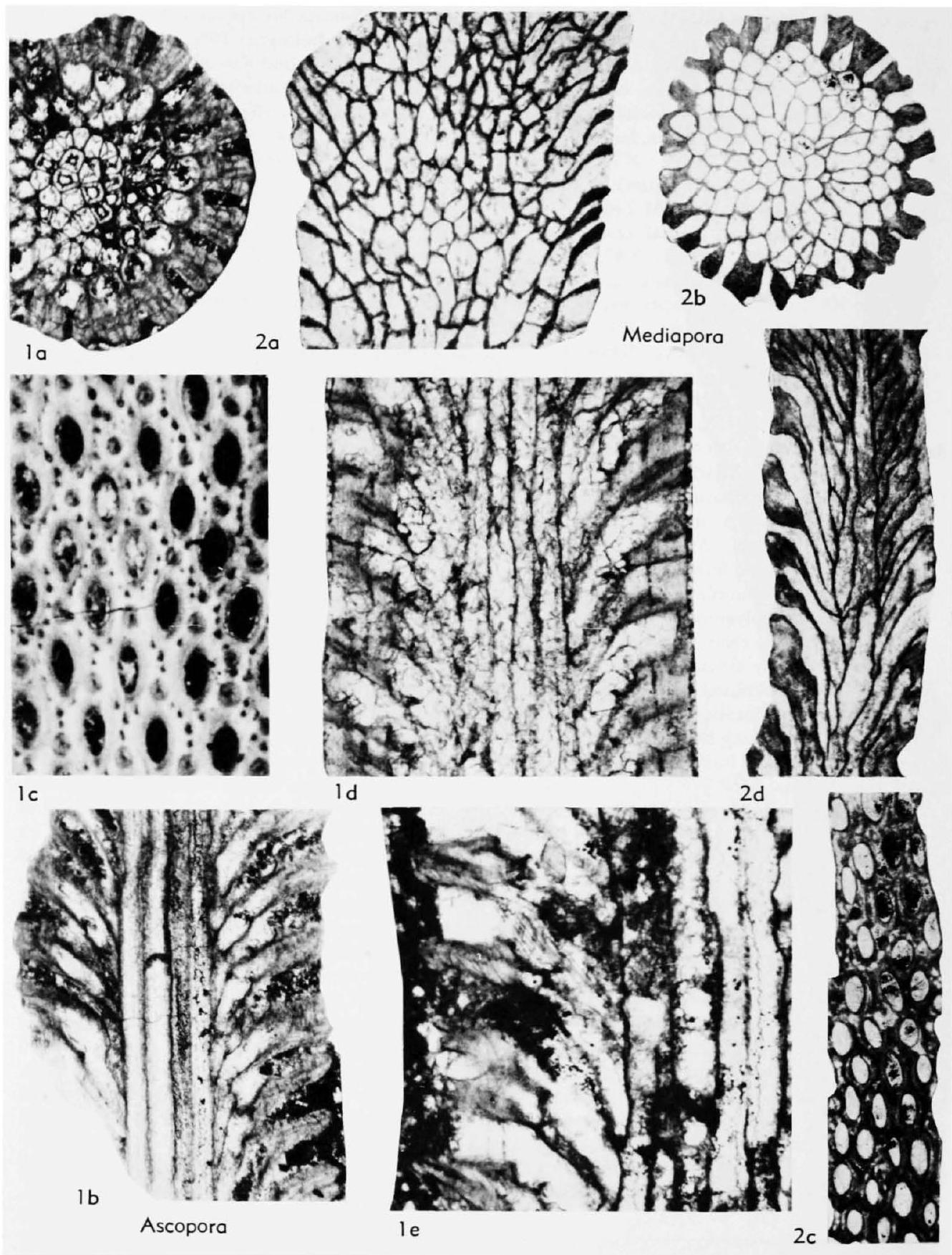 Fig. 283, 1a, b. A. mag- niseptata Shulga-Nesterenko, U. Carb., Russ. plat., USSR, holotype, PIN 136/95, a, axial bundle, zooecial outlines, transv. sec., × 20, b, zooecial shapes, hemisepta, axial zooecia, long. sec., × 20—Fig. 283, 1c. Ascopora sp., Penn.Perm., Nev., USA, living chamber outlines, acanthostyles, paurostyles, tang. sec., USNM 240854, X20—Fig. 283, 1d. Ascopora sp., Earp F., Cisco Gr., U. Penn-Perm., Ariz., USA, zooecial shapes, hemisepta, axial zooecia, long. sec., USNM 240855, X30—Fig. 283, le. Ascopora sp., ?Brazier Ls., Carb. (?Penn. ), Idaho, USA, zooecial shapes, stylets, axial zooecia, long. sec., USNM 240856, × 30
Synonyms
Geographic Distribution
USSR, N.Am., Asia
Age Range
Beginning Stage in Treatise Usage:
L.Carb. (Tournais. or Visean)
Beginning International Stage:
Visean
Fraction Up In Beginning Stage:
0
Beginning Date:
346.73
Ending Stage in Treatise Usage:
L.Perm. (?Artinsk.)
Ending International Stage:
Artinskian
Fraction Up In Ending Stage:
100
Ending Date:
283.3
Description
Zoarium dendroid. Branch diameters 1.0 to 5.5 mm, usually constant between bifurcations. Apertural arrangement rhombic. Axial region formed by weakly to well-defined cylindrical bundle of 4 to 30 axial zooecia. Axial zooecia polygonal in cross section, walls commonly thinner than those of autozooecia; diaphragms usually absent, may be rare. Auto-zooecial bases attenuated to weakly inflated; autozooecia in endozone initially triangular in cross section, becoming hexagonal. Autozooecial divergence from axial abundle mostly between 20° and 45°. Zooecial bend generally abrupt; living chambers commonly oriented about 90° to branch surface. Autozooeciallength mostly 5 to 10 times diameter. Longitudinal arrangement of zooecia usually regular. Single, massive, recurved hemiseptum may be present on proximal wall at zooecial bend; single, slender hemiseptum rarely present on distal wall in late endozone; multiple hemisepta rarely present on proximal wall; or hemisepta may be absent. Autozooecial diaphragms generally absent, may be rare. Exozonal width ranging from less than half branch radius in slender species to about two-thirds branch radius in robust species. Zooecial boundary generally narrow, irregular, granular in some areas; locally not visible; lamellar profile V-shaped in exozone. One or two acanthostyles proximal to each zooecial chamber; orientation relative to zoarial surface may be greater than zooecial angle. Paurostyles common to densely spaced; in single or double rows between apertures, or stylet fields may be present. Mural spines may be present in exozonalliving-chamber wall. Stylets arising in exozone. [Ascopora is distinguished by an axial bundle ofzooecia, zooecial shape, stylet development, and lack of metapores. Location of the types of A. rhombi/era is unknown, and they may be lost (SHERBORN, 1940).]
References
Trautschold, H. A., 1876, Die Kalkbrüche von Mjatschkova. Eine Monographie des oberen Bergkalks: Moskov. O-vo. Ispyt. Prir. Nov. Mem., v. 13, p. 325-374, pl. 32-38.
Museum or Author Information
Classification
Phylum:
Bryozoa
Subphylum:
Ectoprocta
Class:
Gymnolaemata
Order:
Cryptostomata
Suborder:
Rhabdomesina
Family:
Rhabdomesidae
Formal Genus Name and Reference:
Ascopora TRAUTSCHOLD, 1876, p. 367
Type Species:
Millepora rhombifera PHILLIPS, 1836, p. 199, M, Carb., Yorkshire, Eng.
Images
(Click to enlarge in a new window)
Fig. 283, 1a, b. A. mag- niseptata Shulga-Nesterenko, U. Carb., Russ. plat., USSR, holotype, PIN 136/95, a, axial bundle, zooecial outlines, transv. sec., × 20, b, zooecial shapes, hemisepta, axial zooecia, long. sec., × 20—Fig. 283, 1c. Ascopora sp., Penn.Perm., Nev., USA, living chamber outlines, acanthostyles, paurostyles, tang. sec., USNM 240854, X20—Fig. 283, 1d. Ascopora sp., Earp F., Cisco Gr., U. Penn-Perm., Ariz., USA, zooecial shapes, hemisepta, axial zooecia, long. sec., USNM 240855, X30—Fig. 283, le. Ascopora sp., ?Brazier Ls., Carb. (?Penn. ), Idaho, USA, zooecial shapes, stylets, axial zooecia, long. sec., USNM 240856, × 30
Synonyms
Geographic Distribution
USSR, N.Am., Asia
Age Range
Beginning Stage in Treatise Usage:
L.Carb. (Tournais. or Visean)
Beginning International Stage:
Visean
Fraction Up In Beginning Stage:
0
Beginning Date:
346.73
Ending Stage in Treatise Usage:
L.Perm. (?Artinsk.)
Ending International Stage:
Artinskian
Fraction Up In Ending Stage:
100
Ending Date:
283.3
Description
Zoarium dendroid. Branch diameters 1.0 to 5.5 mm, usually constant between bifurcations. Apertural arrangement rhombic. Axial region formed by weakly to well-defined cylindrical bundle of 4 to 30 axial zooecia. Axial zooecia polygonal in cross section, walls commonly thinner than those of autozooecia; diaphragms usually absent, may be rare. Auto-zooecial bases attenuated to weakly inflated; autozooecia in endozone initially triangular in cross section, becoming hexagonal. Autozooecial divergence from axial abundle mostly between 20° and 45°. Zooecial bend generally abrupt; living chambers commonly oriented about 90° to branch surface. Autozooeciallength mostly 5 to 10 times diameter. Longitudinal arrangement of zooecia usually regular. Single, massive, recurved hemiseptum may be present on proximal wall at zooecial bend; single, slender hemiseptum rarely present on distal wall in late endozone; multiple hemisepta rarely present on proximal wall; or hemisepta may be absent. Autozooecial diaphragms generally absent, may be rare. Exozonal width ranging from less than half branch radius in slender species to about two-thirds branch radius in robust species. Zooecial boundary generally narrow, irregular, granular in some areas; locally not visible; lamellar profile V-shaped in exozone. One or two acanthostyles proximal to each zooecial chamber; orientation relative to zoarial surface may be greater than zooecial angle. Paurostyles common to densely spaced; in single or double rows between apertures, or stylet fields may be present. Mural spines may be present in exozonalliving-chamber wall. Stylets arising in exozone. [Ascopora is distinguished by an axial bundle ofzooecia, zooecial shape, stylet development, and lack of metapores. Location of the types of A. rhombi/era is unknown, and they may be lost (SHERBORN, 1940).]
References
Trautschold, H. A., 1876, Die Kalkbrüche von Mjatschkova. Eine Monographie des oberen Bergkalks: Moskov. O-vo. Ispyt. Prir. Nov. Mem., v. 13, p. 325-374, pl. 32-38.